Bookkeeping
Accounting
iDEAL is becoming Wero: what does that mean for your business?
iDEAL is becoming Wero across the Netherlands and Europe. Learn what the Wero migration means for Dutch businesses, VAT, bookkeeping, and the 2027 transition timeline.
•
16 min
Intro
For more than twenty years, iDEAL has dominated online payments in the Netherlands. It became the default checkout option for Dutch consumers and one of the biggest reasons why local e-commerce conversion rates consistently outperformed many neighbouring countries. For Dutch businesses, accepting iDEAL was never a strategic discussion. It was simply mandatory. If your webshop did not support iDEAL, you were immediately limiting your customer base.
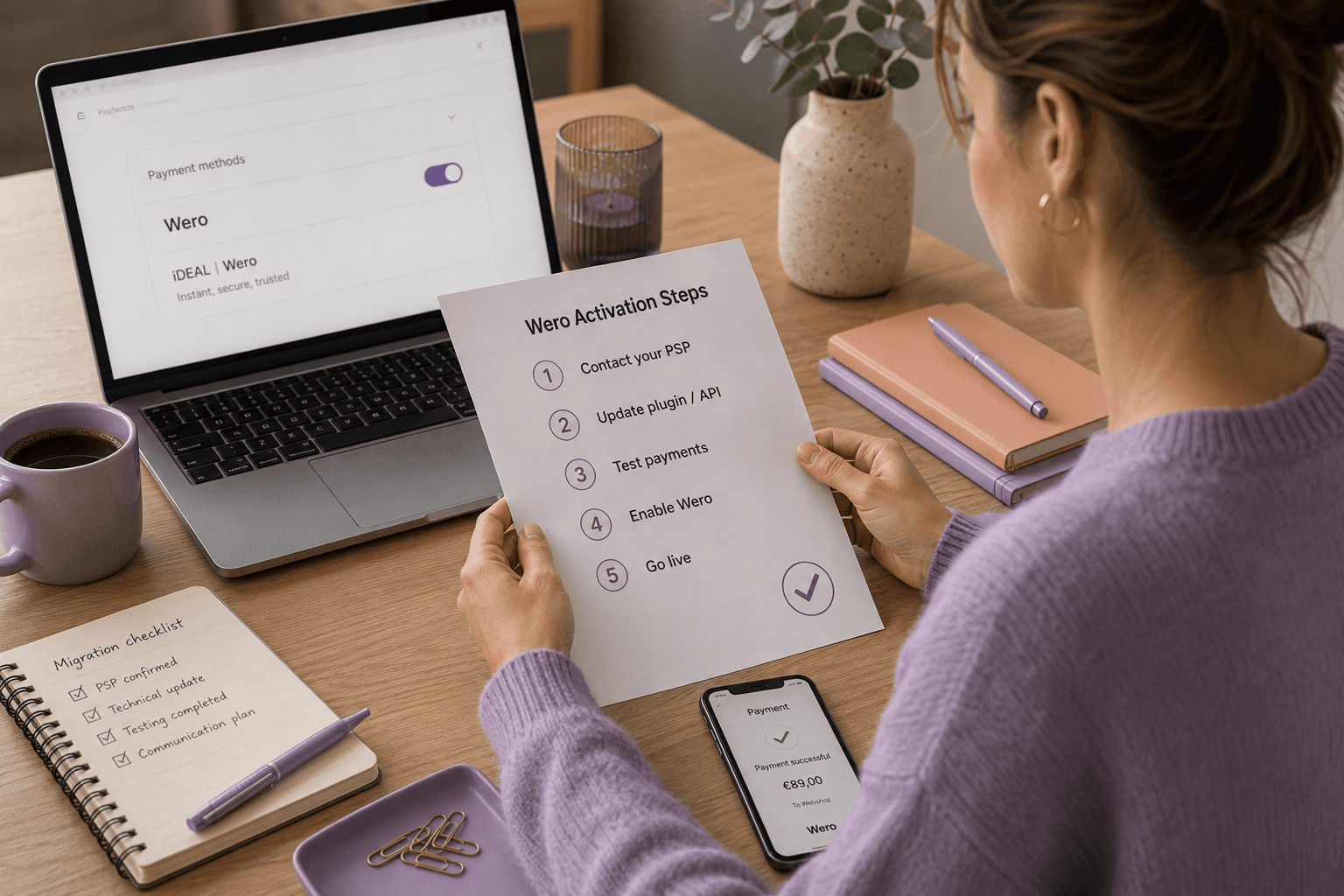
That dominance is now entering a new phase. iDEAL is gradually transitioning into Wero, the new European payment brand developed by the European Payments Initiative (EPI). This is not a sudden shutdown of the familiar iDEAL payment flow. Consumers will still authenticate through their banking apps and merchants will continue receiving instant bank-based payments. The difference is that the infrastructure is becoming European rather than purely Dutch. For Dutch entrepreneurs, this transition affects not only checkout flows, but also PSP relationships, cross-border sales opportunities, VAT exposure, and financial administration processes.
What Is Wero and Why Is It Replacing iDEAL?
Wero is the payment brand created by the European Payments Initiative, commonly referred to as EPI. The initiative is backed by sixteen major European financial institutions, including ABN AMRO, ING, and Rabobank. Its core objective is straightforward: create a European-owned payment infrastructure that can compete with global networks such as Visa, Mastercard, and PayPal while keeping payments within European banking infrastructure.
The transition matters because iDEAL was built specifically for the Dutch market. It works exceptionally well inside the Netherlands, but it does not function as a broader European payment solution. A German or Belgian consumer cannot use iDEAL unless they hold a Dutch-supported banking relationship. Wero changes that dynamic by creating a unified bank-based payment system across participating EU countries.
Several important facts explain why the transition is strategically significant:
iDEAL currently processes more than 1.5 billion transactions annually
Approximately 72% of Dutch e-commerce transactions use iDEAL
Wero already has more than 46 million registered users across Belgium, France, and Germany
EPI now includes over 1,100 members, including banks, PSPs, and acquirers
Mollie became an EPI principal member in early 2026
For merchants, the key takeaway is that this is not a disruptive replacement of the payment mechanics Dutch consumers trust. The same instant bank-account-based infrastructure remains. Wero simply expands it beyond Dutch borders.
DNB, De Nederlandsche Bank, oversees the migration process and supervises both iDEAL and Wero during the transition period.
The iDEAL to Wero Migration Timeline: What Happens When
The migration is happening gradually rather than through a single launch date. That matters because different stages affect merchants in different ways. The early stages are largely cosmetic and consumer-facing. The later stages require real operational work from businesses and PSPs.
Phase | Timeline | What Happens |
Phase 1 | Q1 2026 | Co-branding begins. Merchants replace the iDEAL logo with the combined iDEAL | Wero branding. |
Phase 2 | Throughout 2026 | Backend technical migration begins under DNB supervision. Initial Wero payments start processing. |
Phase 3 | Q4 2026 | Merchant rollout begins. PSP integrations, updated contracts, and cross-border capabilities become operational. |
Phase 4 | Q1-Q3 2027 | Additional Wero functionality launches, including subscriptions, QR invoice payments, and purchase protection. |
Phase 5 | 31 December 2027 | Full iDEAL decommissioning. Wero becomes the only visible payment brand. |
One important nuance: all timelines remain subject to DNB approvals, bank readiness, and PSP integration schedules. The broad direction is fixed, but the exact implementation timing may still vary between providers.
What Wero Means for Dutch Consumers: The Customer Experience
From the consumer perspective, the migration is intentionally designed to feel almost invisible. Dutch shoppers will continue paying through the same familiar banking environments they already use today. A customer banking with ING, Rabobank, or ABN AMRO will still authenticate payments inside their banking app using the same login and confirmation methods they already trust.
The payment journey remains largely identical:
Consumer selects Wero at checkout
Banking app opens automatically
Payment is authenticated
Merchant receives instant confirmation
The familiarity is deliberate. EPI understands that consumer adoption depends heavily on avoiding friction during checkout.
What changes is the broader functionality around that payment flow. Wero introduces features that iDEAL historically lacked:
Purchase protection
Structured dispute resolution
Person-to-person payments
Future subscription functionality
QR-code invoice payments
Loyalty programe integrations
The most commercially important improvement is cross-border usability. A Dutch customer will eventually use the same Wero flow to shop at German or Belgian merchants, and vice versa. That creates a more seamless European payment ecosystem that iDEAL alone could never provide.
What Wero Means for Dutch Merchants: The Practical Impact
For merchants, the transition is more operationally significant than it is for consumers. The migration is not fully automatic. Businesses must actively coordinate with their PSPs and payment infrastructure providers to ensure compatibility before the final migration deadline arrives.
The most important practical point is simple:
Merchants that fail to migrate to Wero risk losing payment capability entirely after 31 December 2027.
That makes PSP readiness the central issue for Dutch businesses.
Several major PSPs have already confirmed Wero support, including:
Mollie
MultiSafepay
Buckaroo
Stripe
Worldline
PAY.NL
Nexi
Unzer
PAYONE
Merchants should explicitly confirm:
whether Wero support is active;
when merchant activation becomes available;
whether new contracts are required;
how reporting changes during the migration.
Wero also changes the merchant opportunity set considerably. Under iDEAL, Dutch webshops needed alternative payment methods such as cards or PayPal to serve German and Belgian consumers. Under Wero, those same consumers can pay directly through their local banking apps using the same infrastructure.
That potentially lowers:
checkout abandonment;
payment processing costs;
dependence on card networks.
The dispute resolution process also changes. iDEAL historically functioned as a direct merchant-consumer relationship. Wero introduces a more structured dispute process tied to purchase protection features. Merchants should understand how this affects chargeback-style disputes before the full rollout begins.
The Logo Update Requirement: What Every Dutch Webshop Must Do
One immediate operational requirement already affected Dutch businesses in 2026: the mandatory co-branded logo update.
Since January 2026, merchants have been required to replace the traditional iDEAL logo with the combined iDEAL | Wero logo across checkout pages, websites, apps, and payment-related communications. The deadline for this change was 31 March 2026.
The update itself is relatively small, but it signals participation in the broader migration process.
Merchants should verify:
checkout pages;
webshop themes;
payment plugins;
confirmation emails;
mobile checkout flows;
printed payment materials.
Many PSPs distribute official logo packs containing:
SVG
PNG
EPS
AI
PDF formats
Some webshop plugins update automatically. Others require manual replacement. Businesses that have not completed the logo update should treat it as an urgent compliance issue.
Cross-Border Payments: The Business Opportunity Wero Creates
The biggest commercial opportunity created by Wero is European reach through a single payment infrastructure.
Historically, Dutch merchants expanding internationally faced fragmented payment setups. German consumers preferred local banking solutions. French customers behaved differently again. Belgian markets required separate optimization. Every country introduced extra checkout complexity.
Wero changes this model fundamentally.
A German consumer will eventually be able to pay a Dutch webshop directly through their German banking environment using the same Wero infrastructure. The Dutch merchant receives the payment through the same PSP environment they already use domestically.
That creates several advantages:
fewer separate payment integrations;
potentially lower payment costs;
simpler European expansion;
higher conversion in neighbouring markets.
The scale is substantial. Wero already reaches more than 46 million users across Belgium, Germany, and France, with further European expansion planned through EPI and EuroPA cooperation initiatives.
There is, however, an important administrative implication. Cross-border B2C sales still trigger EU VAT obligations regardless of the payment method used. Businesses expanding internationally through Wero should review whether OSS registration becomes necessary once EU consumer sales exceed the €10,000 threshold.
If your business starts selling more actively across EU borders, understanding when to file VAT becomes increasingly important.
What Wero Means for Your Financial Administration
For most Dutch businesses, Wero will not fundamentally disrupt bookkeeping processes. The underlying payment mechanics remain bank-account-based and settlement timing stays similar to current iDEAL behaviour.
Still, there are several practical financial administration points entrepreneurs should pay attention to.
PSP Reporting and Reconciliation
During the migration period, businesses should confirm whether their PSP reporting distinguishes between iDEAL and Wero transactions. That matters for:
reconciliation;
reporting consistency;
transaction fee tracking;
migration monitoring.
Cross-Border VAT Exposure
As Wero expands cross-border selling opportunities, businesses may unintentionally increase their EU consumer sales footprint. Once total EU B2C sales exceed €10,000 annually, OSS registration obligations may apply.
Transaction Fee Categorization
Some PSPs may restructure or rename fee categories as part of the Wero migration. Businesses should ensure bookkeeping systems correctly classify:
payment fees;
settlement charges;
dispute fees;
cross-border transaction costs.
For entrepreneurs managing their own administration, the transition is primarily a configuration and reconciliation issue rather than a complete accounting overhaul. Businesses uncertain about setup or reporting structures may benefit from speaking with an accountant or bookkeeper.
The broader financial impact also depends partly on whether your business currently operates as a BV or sole trader, especially when international growth accelerates.
What Dutch Entrepreneurs Should Do Now: A Practical Checklist
The migration timeline still spans multiple years, but businesses should already be preparing operationally. Merchants who wait until late 2027 risk unnecessary disruption.
Here is the practical priority checklist:
Confirm the logo update is complete
Check your checkout pages, payment screens, confirmation emails, and plugins for the combined iDEAL | Wero branding.Verify Wero support with your PSP
Ask your provider directly whether they support the Wero e-commerce scheme and when activation becomes available.Review your merchant contract
Some PSPs may require updated agreements before activating Wero functionality.Assess cross-border VAT exposure
If you plan to sell more actively across the EU, evaluate whether OSS registration becomes necessary.Test future checkout flows
Ensure Wero displays correctly once activated and verify customer payment flows work smoothly.Inform internal finance teams
Bookkeeping and reconciliation procedures may require small updates during the transition.Monitor the final migration deadline
31 December 2027 is the critical date. Businesses still operating iDEAL-only infrastructure after that point may lose payment acceptance capability entirely.
This transition is especially relevant for new entrepreneurs starting a company in the Netherlands or businesses currently getting your KvK number, because payment infrastructure decisions made today should already account for Wero compatibility.
Is Wero Good for Dutch Businesses? Weighing the Benefits and Considerations
The overall direction is positive for most Dutch merchants, particularly businesses with ambitions beyond the domestic market. Wero preserves the strengths that made iDEAL dominant while solving its biggest limitation: lack of European reach.
The genuine advantages are significant:
European cross-border capability
Lower dependency on card networks
Familiar customer experience
Potentially lower transaction costs
Additional features like purchase protection and subscriptions
European-owned infrastructure
Still, businesses should approach the transition realistically.
There are operational considerations:
migration requires active merchant involvement;
PSP readiness differs substantially;
dispute resolution processes are changing;
merchant onboarding timelines vary.
The biggest risk is not the migration itself. The biggest risk is inaction.
Merchants who fail to engage with their PSPs early enough may discover too late that their payment setup is not fully compatible with the post-2027 environment.
As Dutch businesses continue scaling internationally, payment infrastructure becomes part of the broader discussion around how much tax you pay, VAT compliance, and operational efficiency.
Your Payments, Bookkeeping, and Growth Infrastructure in One Place
The transition from iDEAL to Wero is larger than a logo change. For Dutch businesses, it sits at the intersection of payments, bookkeeping, VAT compliance, cross-border growth, and operational scalability. The companies that benefit most from the transition will be the ones that prepare early, keep their financial administration clean, and make sure their payment infrastructure evolves alongside their business.
At Neno, we help Dutch entrepreneurs manage exactly that transition. From incorporate your BV to fully automated bookkeeping and payroll, we combine AI-native financial infrastructure with real accountants who understand how Dutch businesses actually operate. Whether you are updating your PSP setup, expanding internationally through Wero, or preparing your VAT administration for EU sales growth, Neno helps keep your business compliant and operational without adding complexity.
FAQs: iDEAL and Wero for Dutch Businesses
What is Wero and who is behind it?
Wero is the payment brand of the European Payments Initiative (EPI), backed by major European banks including ING, ABN AMRO, and Rabobank.
Is iDEAL being discontinued?
Yes. iDEAL is being gradually phased out and replaced by Wero, with full decommissioning planned for 31 December 2027.
When will iDEAL be replaced by Wero in the Netherlands?
The migration began in 2026 and completes on 31 December 2027, subject to regulatory and PSP rollout schedules.
Do I need to do anything as a Dutch merchant?
Yes. Merchants should confirm PSP support, update branding, review contracts, and prepare for eventual Wero activation.
Will my customers notice the change?
Probably very little. Consumers will continue using familiar banking apps and similar checkout flows.
Does Wero work the same way as iDEAL?
Largely yes. Payments remain bank-account-based and instantly confirmed, but Wero adds cross-border functionality and additional features.
What happens to my existing iDEAL integration?
Most integrations will migrate gradually through PSP updates, though some merchants may need contract or plugin updates.
Can I use Wero to accept payments from customers in Germany or Belgium?
Yes. That is one of the biggest advantages of Wero compared to iDEAL.
Does accepting Wero change my VAT obligations?
The payment method itself does not change VAT rules, but increased cross-border EU sales may trigger OSS obligations.
What if my PSP does not support Wero?
You may eventually lose payment acceptance capability after iDEAL is fully decommissioned in 2027. Contact your PSP early to confirm their migration timeline.

Written by
Nick Knuppe
CEO & Founder