Accounting
How to start a company in the Netherlands in 2026: types, costs & process
Learn how to start a company in the Netherlands in 2026. Explore legal forms, costs, registration steps, and requirements for entrepreneurs.
•
25 min
Intro
The Netherlands remains one of the most attractive places in Europe to start a business in 2026. A stable legal system, business-friendly tax environment and direct access to the EU market make it a strong base for both small ventures and growing companies. The country also ranks highly for ease of doing business, with clear regulations and efficient public institutions that support entrepreneurs at every stage.
At the same time, starting a company still involves important decisions around structure, costs and compliance. Choosing between a BV and a sole proprietorship, understanding registration steps and planning for taxes can have long-term impact on how a business operates. With ongoing digitalization of government services and faster setup options, the process is becoming more efficient, but knowing how it works in practice remains essential.
Why Start a Business in the Netherlands in 2026
The Netherlands continues to offer a strong foundation for entrepreneurs due to its strategic location, stable economy and highly developed infrastructure. Businesses benefit from easy access to the European single market, efficient logistics networks and a well-connected digital ecosystem. English is widely used in business, which lowers the barrier to entry and simplifies day-to-day operations.
Another key advantage is the transparent regulatory and tax environment. The Dutch system provides clear rules for company formation, VAT and corporate taxation, along with incentives for innovation and international trade. Combined with ongoing digitalization of public services, this creates a predictable and relatively efficient environment for starting and running a business.
Key advantages of the Dutch business environment
The country is known for its open economy and strong focus on entrepreneurship. It supports startups and established businesses through access to funding, innovation hubs and a skilled workforce. Reliable institutions and a high level of legal certainty make it easier to build and scale a company with confidence.
Tax system, innovation incentives and EU access
The Netherlands offers competitive corporate tax rates and various schemes that support innovation, such as tax relief for research and development activities. Being part of the EU also allows companies to trade freely across member states, which is especially valuable for businesses planning to grow beyond the local market.
Who can start a business in the Netherlands
There are generally no strict restrictions on who can start a business, and both residents and non-residents can register a company under certain conditions. Requirements depend on the chosen legal structure and whether the entrepreneur needs to be physically present for registration or identification.
What Types of Companies Can You Start in the Netherlands
Choosing the right legal structure is one of the first and most important decisions when starting a business in the Netherlands. The structure affects liability, taxes, administrative workload and how the business can grow over time. In 2026, most entrepreneurs choose between a BV and a sole proprietorship, but there are several options depending on the nature and scale of the activity.
Each structure comes with its own requirements and trade-offs. Some are quick and low-cost to set up but offer less protection, while others require more formalities but provide better scalability and risk separation. Understanding these differences early helps avoid restructuring later.
Dutch BV (private limited company)
A BV is the most common structure for scalable businesses and startups. It is a separate legal entity, which means the company is liable for its obligations rather than the founder personally. This structure is often preferred when working with partners, hiring employees or planning to raise investment.
Setting up a BV involves incorporation through a notary and registration with the Chamber of Commerce. It also comes with corporate tax obligations and stricter administrative requirements compared to simpler structures.
ZZP / Eenmanszaak (sole trader)
A sole proprietorship, often referred to as ZZP, is the simplest way to start a business. It is quick to register, has low setup costs and minimal administrative burden. This makes it popular among freelancers, consultants and small service providers.
However, there is no legal separation between the business and the owner. This means the entrepreneur is personally liable for debts and obligations, which can become a risk as the business grows.
VOF (general partnership)
A VOF is used when two or more individuals start a business together without forming a separate legal entity. It is relatively easy to set up and allows partners to share responsibilities and profits.
Like a sole proprietorship, partners are personally liable for the business. Clear agreements between partners are important to avoid conflicts and define roles, responsibilities and profit distribution.
Foundation (Stichting) and other structures
A Stichting is typically used for non-profit or purpose-driven activities. It does not have shareholders and is managed by a board. While it can be used in certain business structures, it is less common for standard commercial activities.
Other forms exist, but they are used in more specific situations. Most entrepreneurs will choose between BV, ZZP or partnership structures depending on their goals.
BV vs ZZP: which is better in 2026
The choice between BV and ZZP depends on income level, risk exposure and long-term plans. A ZZP structure works well for individuals starting small or testing a business idea. A BV becomes more attractive when profits increase, risks grow or when external investment is involved.
Taxation also plays a role, as the two structures are taxed differently. Many entrepreneurs start as ZZP and switch to a BV once the business reaches a certain level.
When to switch from ZZP to BV
Switching from a sole proprietorship to a BV is a common step as a business grows. This often happens when profits increase to a level where corporate tax becomes more efficient or when liability protection becomes important.
Other triggers include hiring employees, working with larger clients or preparing for investment. Planning the transition at the right time helps optimize both tax and operational structure.
Step-by-Step Process to Start a Company in the Netherlands
Starting a business in the Netherlands follows a clear sequence of steps, but the exact process depends on the legal structure you choose. While registering as a sole trader can be completed quickly, setting up a BV involves additional legal and administrative stages. In both cases, proper preparation helps avoid delays and ensures compliance from the start.
The process typically involves registration with the Chamber of Commerce, tax setup and arranging essential operational elements such as banking and accounting. In recent years, parts of this process have become more streamlined, but each step still plays a critical role in getting a business fully operational.
Step 1 – Choose your legal structure
The first step is selecting the appropriate legal form based on your business model, expected revenue and risk level. This decision determines how your business is taxed, your level of personal liability and the administrative requirements you will face.
It is important to consider both short-term simplicity and long-term scalability. Changing structure later is possible, but it often involves additional costs and administrative work.
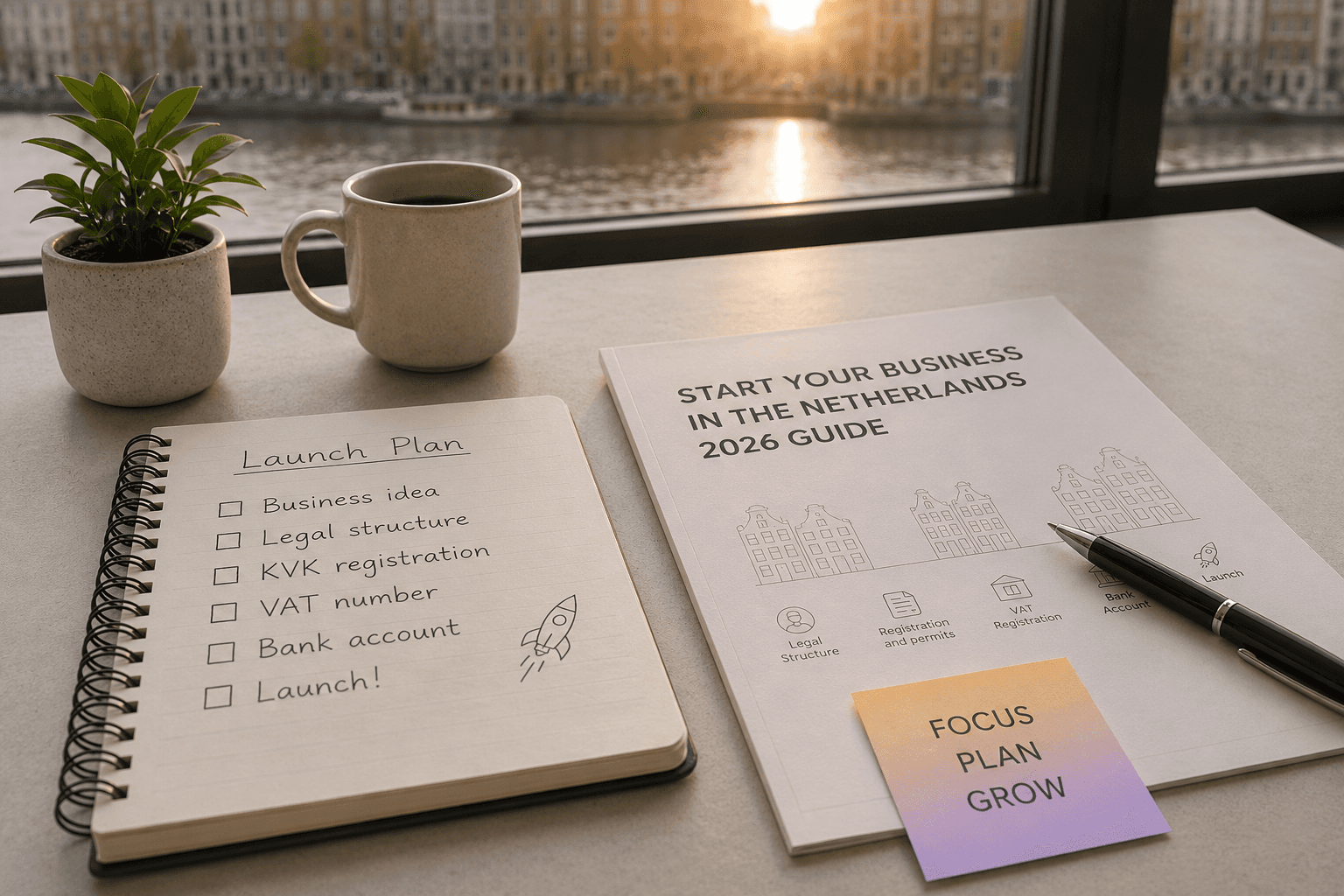
Step 2 – Register with the Dutch Chamber of Commerce (KVK)
All businesses must be registered with the Chamber of Commerce. This registration officially creates the business and assigns it a unique KVK number, which is required for invoices, contracts and legal operations.
For sole traders, this usually involves booking an appointment and confirming identity. For BVs, registration happens after incorporation through a notary.
Step 3 – Register with the Belastingdienst (tax office)
After registration, the business is automatically or manually registered with the Dutch tax authorities. You will receive a VAT number if your activities require it, which is necessary for charging and reclaiming VAT.
Understanding your tax obligations early is important, as it affects pricing, invoicing and compliance from the first transaction.
Step 4 – Open a business bank account
A business bank account is required for most company structures, especially for BVs. It separates personal and business finances and is often needed to complete incorporation and ongoing administration.
Opening an account can vary in complexity depending on the provider, with traditional banks sometimes requiring extensive checks and documentation.
Step 5 – Set up accounting and VAT administration
Proper bookkeeping is a legal requirement in the Netherlands. Businesses must track income, expenses and VAT, and submit periodic tax filings.
Setting up accounting from the beginning helps avoid errors and ensures that financial data is accurate and up to date.
Step 6 – Obtain licenses if required
Some industries require additional permits or licenses before operating. This depends on the type of business and sector regulations.
Checking requirements in advance prevents legal issues and ensures that the business can operate without interruptions once registered.
Traditional Company Formation Process in the Netherlands
Until recently, starting a company in the Netherlands often required several in-person steps and coordination between different parties. This was especially true for BVs, where legal formalities and identity verification were handled physically. While the process was reliable, it could be time-consuming and less flexible for entrepreneurs who were not locally present.
The traditional route is still used today, particularly in more complex cases or when specific legal arrangements are required. However, it often involves multiple appointments, longer timelines and dependency on third parties such as notaries and banks.
Visiting a notary for BV incorporation
Forming a BV traditionally requires a notary to draft and execute the deed of incorporation. This includes defining the company structure, shareholders and articles of association.
The process usually involves reviewing documents, confirming identities and signing the incorporation deed in person. This step is mandatory for establishing the legal entity.
Physical appointment with KVK
Business registration typically requires an appointment with the Chamber of Commerce to verify identity and confirm business details. For sole traders, this is often the main step in the process.
Appointments need to be scheduled in advance, and availability can affect how quickly the business can be registered.
Opening a bank account in person
Traditional banks often require founders to visit a branch to open a business account. This includes identity checks, document verification and compliance procedures.
The process can take time, especially if additional information is requested or if the business structure is more complex.
Typical timeline using the traditional route
The full setup process can take anywhere from a few days for a sole trader to several weeks for a BV. Delays can occur due to scheduling appointments, document preparation and bank onboarding.
Each step depends on the previous one, which can extend the overall timeline if not managed efficiently.
Common friction points (paperwork, delays, coordination)
Entrepreneurs often face challenges such as collecting the required documents, coordinating between notaries and banks, and dealing with administrative delays. These issues can slow down the process and create uncertainty around launch timelines.
While the system is structured and reliable, it is not always optimized for speed or remote setup, which has led to increasing demand for more flexible alternatives.
Starting a Company in the Netherlands Online (2026 Update)
The process of starting a company in the Netherlands has become significantly more digital in recent years. Government institutions, notaries and financial providers have introduced online identification, digital document handling and remote verification. This shift has reduced the need for physical appointments and made it easier to manage the setup process from anywhere.
As a result, entrepreneurs can now complete large parts of company formation faster and with fewer dependencies. While not every case is fully remote, the overall experience is more streamlined, especially for standard business structures and straightforward setups.
Can you start a Dutch company fully online?
In many cases, it is now possible to complete most steps online, including document submission, identity verification and registration. This depends on the legal structure and whether all compliance requirements can be met digitally.
For sole traders, parts of the process may still involve identity confirmation, while BVs can increasingly be incorporated using digital notary services and remote procedures.
What has changed in 2025–2026 (digital incorporation, eID, remote verification)
Recent updates have focused on enabling secure digital identification and remote processing of legal documents. Electronic identification methods and online verification tools are now widely accepted across institutions.
These changes allow faster onboarding and reduce the need for physical presence, especially when combined with digital-first service providers.
How online incorporation works step by step
The process typically starts with submitting company details and required documents through an online platform. Identity verification is completed remotely, followed by digital preparation and signing of incorporation documents.
Once completed, registration with the Chamber of Commerce and tax authorities is handled as part of the workflow, reducing manual coordination between different parties.
Timeline for online vs traditional setup
Online incorporation can significantly reduce setup time, especially for straightforward cases. While traditional processes may take several weeks for a BV, digital routes can shorten this to a few days once all documents are in place.
The exact timing depends on verification steps, complexity of the structure and responsiveness during the process.
How platforms simplify company formation, banking and accounting
Newer platforms are changing how businesses are set up by combining company formation, banking and accounting into one connected system. Instead of dealing separately with a notary, the Chamber of Commerce, a bank and an accountant, the process is handled through a single workflow. This reduces back and forth communication and helps ensure that each step is aligned from the beginning.
Neno brings together incorporation, business banking and ongoing financial administration in one place. This allows entrepreneurs to register a company, open an account and manage bookkeeping without switching between providers or repeating the same information multiple times. By integrating these elements, the setup process becomes faster and more predictable, while ongoing operations such as invoicing, VAT filing and payroll can be managed within the same environment.
When you may still need physical presence
Despite the shift to digital processes, some situations still require in-person involvement. This may include complex ownership structures, specific regulatory requirements or cases where additional verification is needed.
In these instances, a hybrid approach is often used, combining online preparation with targeted physical steps where necessary.
How Long Does It Take to Start a Company in the Netherlands
The time required to start a company in the Netherlands depends on the chosen legal structure and the method of registration. Some businesses can be registered within a few days, while others may take several weeks due to legal formalities and verification steps. Preparation, document readiness and the choice between traditional and online processes all influence the overall timeline.
In 2026, timelines have improved due to digitalization, but certain steps such as identity verification, notarial involvement and bank onboarding can still introduce delays. Understanding the expected timeframe helps with planning operations and setting realistic launch expectations.
Timeline for ZZP registration
Registering as a sole trader is typically the fastest option. Once an appointment with the Chamber of Commerce is completed and identity is verified, the business can often be active within the same day or shortly after.
VAT registration may take a few additional days, but most entrepreneurs can begin operating almost immediately after KVK registration.
Timeline for BV formation (traditional vs online)
Setting up a BV traditionally takes longer due to the involvement of a notary and additional legal steps. The process can take anywhere from one to several weeks depending on scheduling, document preparation and bank account approval.
With online incorporation, timelines can be reduced significantly. In straightforward cases, a BV can be established within a few days once all required information and verification steps are completed.
Factors that can delay the process
Delays often occur due to incomplete documentation, scheduling issues or extended compliance checks by banks. Complex ownership structures or international elements can also slow down verification and approval.
Being prepared with all necessary information and choosing a streamlined setup process can help minimize these delays and ensure a faster start.
Costs of Starting a Business in the Netherlands in 2026
The cost of starting a business in the Netherlands varies depending on the legal structure, the service providers involved and the level of support required. Some businesses can be launched with minimal upfront costs, while others require higher initial investment due to legal and administrative requirements. Understanding these costs early helps with budgeting and avoiding unexpected expenses.
In addition to setup costs, there are ongoing expenses related to compliance, accounting and banking. These should be considered as part of the overall cost of running a business, not just the initial registration.
KVK registration fees
All businesses must register with the Chamber of Commerce, which involves a one-time registration fee. This cost is relatively low and applies to both sole traders and companies.
It is a mandatory step and one of the smallest expenses in the overall setup process.
Notary costs for BV formation
Setting up a BV requires a notary to draft and formalize the incorporation deed. This is one of the main upfront costs when choosing this structure.
Fees can vary depending on the complexity of the company structure and the notary involved, but it is typically a few hundred to over a thousand euros.
Accounting and compliance costs
Businesses in the Netherlands are required to maintain proper financial records and submit tax filings. Many entrepreneurs choose to work with an accountant or use accounting software to manage this.
Costs depend on the size of the business and level of support, ranging from basic software subscriptions to full-service bookkeeping.
Business bank account costs
Opening and maintaining a business bank account usually involves monthly fees, along with potential transaction costs. Pricing varies between providers and depends on the services included.
Some digital solutions offer more streamlined pricing, while traditional banks may have more complex fee structures.
Ongoing costs (VAT, bookkeeping, payroll)
Beyond setup, businesses must account for recurring expenses such as VAT filings, bookkeeping and payroll if employees are involved. These costs grow with the size and complexity of the business.
Planning for these expenses ensures that the business remains compliant and financially stable over time.
Total estimated cost: ZZP vs BV
A sole proprietorship can be started with relatively low upfront costs, often limited to registration and basic setup. A BV requires higher initial investment due to notary fees and additional legal steps.
However, the choice should not be based on cost alone. Tax efficiency, liability and long-term business goals are equally important when deciding between structures.
Do You Need a Dutch Address or Residency
Starting a business in the Netherlands does not always require full residency, but there are specific conditions depending on the structure and situation. Requirements around address registration, identification and local presence can affect how the setup process works in practice. Understanding these rules early helps avoid complications during registration.
In 2026, there is more flexibility due to digital processes, but certain legal and administrative requirements still apply. These are particularly relevant for founders who are not physically based in the Netherlands or who plan to manage the business remotely.
Can non-residents start a Dutch company
Non-residents can start a company in the Netherlands, especially when setting up a BV. The country allows foreign ownership, and there are no strict nationality restrictions for shareholders.
However, additional verification steps may apply, and in some cases, having a local director or representative can simplify the process.
Registered business address requirements
Every business must have a registered address in the Netherlands. This address is used for official communication and must be valid for registration with the Chamber of Commerce.
It does not always have to be a physical office, but it must meet legal requirements and be accessible for administrative purposes.
Director requirements for a BV
A BV must have at least one director, who is responsible for managing the company. The director does not always need to be a Dutch resident, but their details must be registered and verified.
In some cases, having a locally based director can make certain processes, such as banking or compliance, more straightforward.
BSN number and when it is required
A BSN number is a personal identification number used in the Netherlands. It is required in certain situations, particularly for individuals who live or work in the country.
For non-residents, alternative identification methods may be used depending on the structure and setup process.
Taxes and Obligations After Starting Your Business
Starting a company in the Netherlands comes with ongoing tax and administrative responsibilities. These obligations begin as soon as the business is registered and active. Staying compliant requires understanding how different taxes apply to your structure and ensuring that filings are submitted on time.
The Dutch system is known for being structured and transparent, but it still requires consistent record-keeping and reporting. Whether operating as a sole trader or a BV, proper financial management is essential to avoid penalties and maintain a healthy business.
VAT (BTW) registration and filing
Most businesses must register for VAT and charge it on their products or services. After registration, you receive a VAT number and are required to submit periodic VAT returns.
Filing frequency depends on the business, but it is commonly done quarterly. Accurate tracking of income and expenses is necessary to calculate the correct VAT amounts.
Corporate income tax for BV
A BV is subject to corporate income tax on its profits. The company files annual tax returns and pays tax based on its earnings.
In addition, directors who receive a salary must comply with specific rules regarding minimum compensation, which affects overall tax planning.
Income tax for ZZP
Sole traders pay income tax on their business profits as part of their personal tax return. The system includes various deductions and allowances that can reduce the overall tax burden.
This structure is simpler than a BV but does not provide separation between personal and business finances.
Payroll taxes if you hire employees
If the business hires employees, it must handle payroll taxes and social security contributions. This includes withholding taxes from salaries and submitting them to the tax authorities.
Employers also have additional administrative responsibilities related to employment contracts and reporting.
Annual reporting and compliance requirements
Businesses must maintain proper financial records and, in the case of a BV, file annual accounts. These reports provide an overview of the company’s financial position and are part of legal compliance.
Keeping records organized and up to date makes it easier to meet deadlines and reduces the risk of errors or penalties.
Opening a Business Bank Account in the Netherlands
A business bank account is a key part of setting up a company in the Netherlands, especially for BVs where it is a formal requirement. It ensures a clear separation between personal and business finances and is often needed for invoicing, tax reporting and daily operations. Having a dedicated account also improves financial transparency and simplifies bookkeeping.
The process of opening a business account can vary depending on the provider. Traditional banks often require more documentation and verification, while newer digital solutions focus on faster onboarding and simplified processes.
Is a Dutch business bank account mandatory
For BVs, a business bank account is generally required to operate properly and meet legal and administrative standards. It is also needed to manage share capital and company transactions.
For sole traders, it is not always legally mandatory, but it is strongly recommended to keep finances organized and compliant.
Requirements to open an account
Banks typically require company registration details, identification of directors or owners and information about business activities. For BVs, incorporation documents and shareholder details are also needed.
Additional checks may be carried out as part of compliance procedures, especially for businesses with international elements.
Challenges with traditional banks
Opening a business account with a traditional bank can take time due to strict verification and onboarding processes. Entrepreneurs may face delays if documentation is incomplete or if additional checks are required.
In some cases, non-residents or newly formed companies may find it more difficult to meet all requirements quickly.
Faster alternatives and digital solutions
Digital providers have simplified the process by offering online onboarding and quicker verification. This allows businesses to open accounts faster and start operating without long waiting times.
These solutions often integrate with accounting tools, making it easier to manage finances, track transactions and stay compliant from the beginning.
Common Mistakes When Starting a Business in the Netherlands
Starting a business in the Netherlands is relatively straightforward, but certain mistakes can create unnecessary delays, costs or compliance issues. Many of these problems come from misunderstanding legal requirements or underestimating administrative responsibilities. Avoiding them early can save time and help build a more stable foundation.
Most issues arise during the setup phase or within the first months of operation. Being aware of common pitfalls allows entrepreneurs to make better decisions and avoid having to fix structural problems later.
Choosing the wrong legal structure
Selecting a structure based only on simplicity or low cost can lead to problems as the business grows. For example, starting as a sole trader may seem easier, but it can create risks if liability increases or profits rise.
It is important to consider long-term plans, expected revenue and risk exposure before deciding on the structure.
Underestimating tax and admin obligations
Some entrepreneurs focus on registration but overlook ongoing responsibilities such as VAT filings, bookkeeping and tax deadlines. Missing these obligations can result in penalties and administrative stress.
Setting up proper systems from the beginning helps ensure compliance and keeps financial records organized.
Delays due to incomplete documentation
Missing or incorrect documents can slow down registration, bank account opening and tax setup. This is especially common when dealing with multiple parties such as notaries and financial institutions.
Preparing all required information in advance helps avoid unnecessary back and forth.
Not setting up accounting from day one
Delaying accounting setup can lead to disorganized records and difficulties with tax filings. Even in the early stages, tracking income and expenses accurately is essential.
Using accounting tools or professional support from the start makes it easier to stay compliant and maintain a clear financial overview.
The Fastest Way to Start a Company in 2026
Starting a company in the Netherlands involves clear steps, but the experience can vary significantly depending on the approach. Traditional methods remain reliable but often require more time and coordination, while newer digital processes offer faster and more streamlined setup.
Choosing the right structure, preparing documentation in advance and using efficient tools can reduce delays and simplify the process. With the right setup, businesses can become operational quickly and focus on growth rather than administration.
FAQ: Starting a Company in the Netherlands
Many questions around starting a business in the Netherlands focus on practical concerns such as residency, timelines and legal requirements. These are some of the most common points entrepreneurs look for before getting started.
Can I start a company in the Netherlands without living there
Yes, it is possible to start a company without being a resident, especially when setting up a BV. However, additional verification steps may apply, and certain requirements such as having a registered address must still be met.
What is the fastest way to register a business in the Netherlands
Registering as a sole trader is usually the fastest option and can often be completed within a few days. For BVs, using a streamlined or digital process can significantly reduce setup time.
Do I need a notary for a Dutch BV
Yes, a notary is required to incorporate a BV and formalise the company’s legal structure. This step is mandatory under Dutch law.
Can I open a business remotely
In many cases, parts of the process can be completed remotely, including company formation and banking. However, some situations may still require identity verification or additional checks.
What is the minimum capital for a BV in 2026
A BV can be started with a minimum share capital of just 1 euro. In practice, higher capital may be used depending on the business needs.
Is the Netherlands good for starting a business
The Netherlands offers a stable economy, clear regulations and strong access to European markets. These factors make it a popular choice for entrepreneurs looking to build and scale a business.

Written by
Nick Knuppe
CEO & Founder