Bookkeeping
Accounting
Taxes
Much tax do you pay as an entrepreneur in the Netherlands in 2026?
How much tax do entrepreneurs pay in the Netherlands in 2026? Learn how Dutch income tax, corporate tax, VAT, dividend tax, and DGA salary rules work for sole traders, ZZP'ers, and bv owners.
•
18 min
Intro
Running a business in the Netherlands means dealing with a tax system that changes depending on how your company is structured. A sole trader and a bv owner can generate the exact same profit while ending up with completely different tax obligations, filing requirements, and planning opportunities. For entrepreneurs starting a company in the Netherlands, understanding how the Dutch tax system works is not something that can be postponed until year-end. It directly affects pricing, cash flow, salary decisions, dividend planning, and the long-term structure of the business.
The Dutch system also becomes more important as your company grows. The moment a business moves from freelancing income into recurring profits, hires employees, or starts retaining earnings inside a bv, tax planning stops being theoretical. Decisions about salary, dividend distributions, VAT, and deductible expenses begin to materially affect how much money stays inside the business and how much reaches the founder personally. If you are still deciding whether to get your KvK number as a sole trader or through a bv, the rules covered here will directly shape that decision. The rules continue to evolve every year, and 2026 introduces several updates that entrepreneurs should understand before making structural decisions.
The Dutch Tax System Explained: Three Boxes With Different Rules
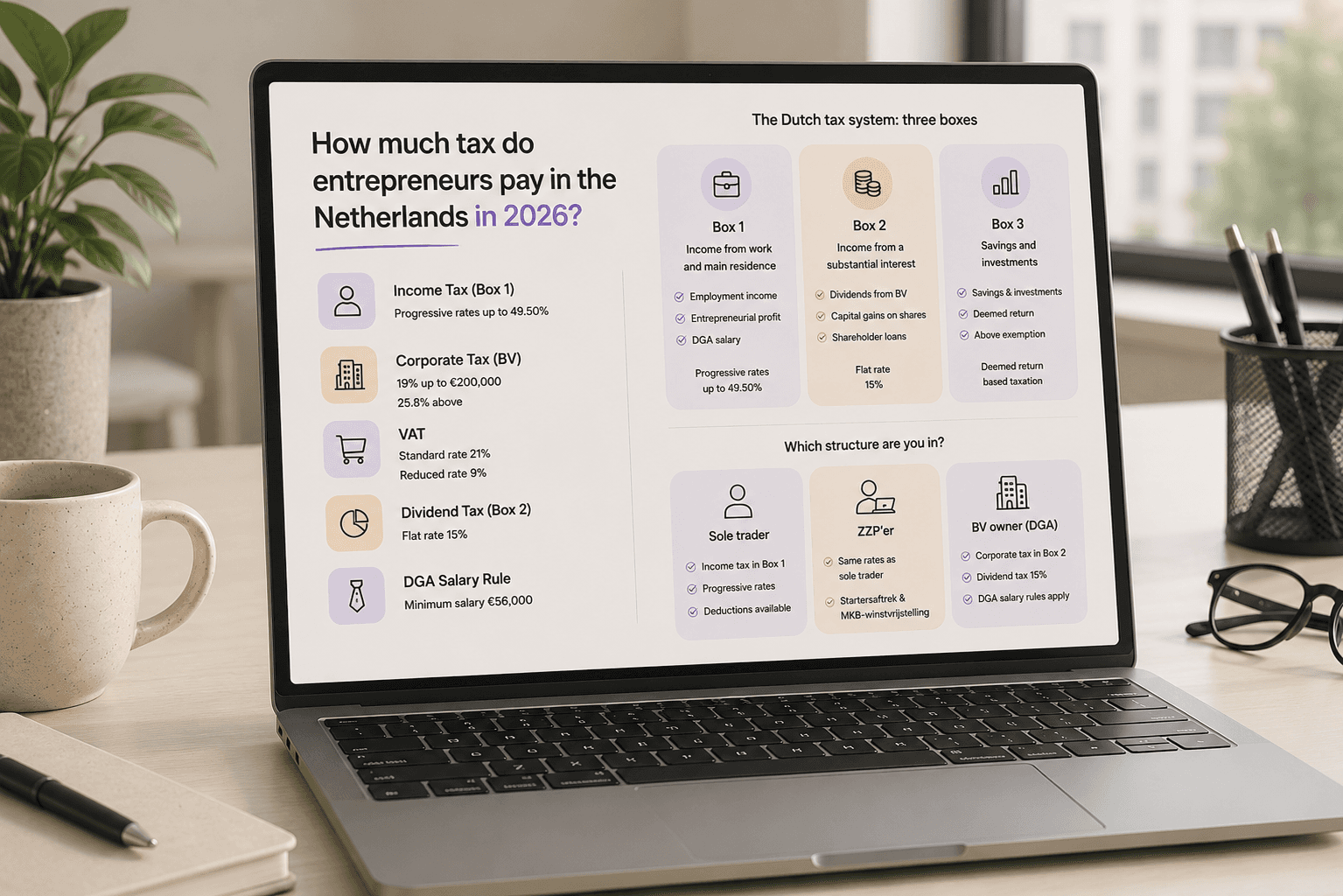
The Netherlands taxes income through a three-box system. Each box covers a different category of income and applies its own rates, deductions, and rules. For entrepreneurs, understanding which income falls into which box is the foundation of all tax planning, because the type of income determines both the applicable rate and the available deductions.
Box 1: Income From Work and Main Residence
Box 1 covers employment income, entrepreneurial profit for sole traders, and income related to the primary residence. Entrepreneurs operating through a sole proprietorship, vof, or maatschap pay tax on their business profit entirely through box 1.
This means:
sole trader profit is taxed progressively
deductions reduce taxable income
tax credits lower the final tax bill
For DGA entrepreneurs operating through a bv, salary income also falls into box 1.
Box 2: Income From a Substantial Interest
Box 2 applies to income from a substantial shareholding. In practice, this means:
dividends from a BV
capital gains on shares
shareholder loan corrections under the excess borrowing rules
A shareholder with at least 5% ownership in a company falls into box 2. For DGA founders, this is the tax box that applies to dividend income.
Box 3: Savings and Investments
Box 3 taxes private wealth and investments above the annual exemption threshold. Instead of taxing actual returns directly, the Dutch system applies a deemed return methodology.
Box 3 applies to:
savings
investment portfolios
certain real estate investments
excess private assets
Although box 3 is not business income, it still matters for entrepreneurs because retained private wealth can create significant additional annual tax exposure.
For most entrepreneurs, the real tax planning interaction happens between box 1 and box 2. A sole trader pays everything through box 1. A BV entrepreneur splits income between:
corporate income tax inside the BV
DGA salary taxed in box 1
dividend taxed in box 2
That layered structure creates flexibility, but also introduces extra compliance obligations.
Box 1 Income Tax Rates in the Netherlands for 2026
Dutch box 1 income tax uses a progressive system. The rates for 2026 are:
Taxable income | Rate |
|---|---|
Up to €38,883 | 35.75% |
€38,883 to €78,426 | 37.56% |
Above €78,426 | 49.50% |
These rates combine income tax, national insurance contributions, and social security premiums. Entrepreneurs who have reached AOW pension age pay reduced rates in the lower brackets because they no longer contribute to the AOW component.
One important detail for higher earners is the deduction cap. Once taxable income exceeds €78,426, deductions such as the zelfstandigenaftrek and MKB-winstvrijstelling no longer generate relief at the top 49.5% rate. Instead, the benefit is capped at 37.56%. This significantly reduces the practical value of deductions at higher income levels.
On top of box 1 tax, sole traders also pay the healthcare contribution (ZVW-bijdrage). In 2026 the rate is 4.85% on taxable profit up to the applicable cap.
Tax Deductions for Sole Traders and ZZP'ers in 2026
Entrepreneurs operating as sole traders or ZZP'ers have access to several deductions that are unavailable to bv structures. These deductions can materially reduce the effective tax burden, especially in the earlier stages of a business.
Zelfstandigenaftrek (Self-Employed Deduction)
The zelfstandigenaftrek continues to decrease in 2026. The deduction is:
€1,200 in 2026
down from €2,470 in 2025
and down sharply from previous years
To qualify, entrepreneurs must satisfy the Dutch hours criterion: at least 1,225 hours spent annually on the business. The government plans to reduce the deduction further in future years.
Startersaftrek (Startup Deduction)
New entrepreneurs who qualify for the zelfstandigenaftrek can claim an additional startup deduction of €2,123. This is available for up to three years within the first five years of entrepreneurship. Combined with the zelfstandigenaftrek, qualifying starters can deduct €3,323 in 2026.
MKB-Winstvrijstelling
The MKB profit exemption exempts 12.7% of taxable entrepreneurial profit after deductions. Unlike the zelfstandigenaftrek:
no hours criterion applies
all qualifying entrepreneurs may use it
This exemption significantly lowers the effective tax burden for most sole traders.
Investment Deduction (KIA)
Entrepreneurs investing in business assets may qualify for the kleinschaligheidsinvesteringsaftrek. In 2026:
qualifying investments between €2,901 and €392,230 can generate additional deductions
the deduction can reach up to 28% of the investment amount
each qualifying asset must cost at least €450
Deductible Business Expenses
Legitimate business expenses remain deductible, including:
office expenses
software subscriptions
travel
equipment
insurance
professional education
The Belastingdienst requires expenses to have a demonstrable business purpose.
Tax Credits
In addition to deductions, entrepreneurs benefit from tax credits including the algemene heffingskorting and the arbeidskorting. Unlike deductions, credits reduce the final tax bill directly.
How Much Tax Does a ZZP Entrepreneur Actually Pay?
Consider a ZZP entrepreneur generating €80,000 profit in 2026 while qualifying for the zelfstandigenaftrek and meeting the hours criterion.
Step 1: Apply Deductions
Amount | |
|---|---|
Starting profit | €80,000 |
Zelfstandigenaftrek | minus €1,200 |
Remaining profit | €78,800 |
MKB-winstvrijstelling (12.7%) | minus €10,004 |
Remaining taxable income | €68,796 |
Step 2: Apply Box 1 Tax Rates
Bracket | Tax |
|---|---|
First bracket | approx. €13,901 |
Second bracket | approx. €11,237 |
Total before credits | approx. €25,138 |
Step 3: Apply Tax Credits and Healthcare Contribution
The general tax credit and employment tax credit reduce the final amount further. Then add the ZVW healthcare contribution at approximately 4.85% up to the cap.
The effective tax burden for many sole traders at this income level lands roughly between 30% and 38% of gross profit. The important point is that taxable profit and gross profit are not the same thing.
Corporate Income Tax for Dutch BVs in 2026
A Dutch BV is taxed separately from its shareholders. The company itself pays corporate income tax (vennootschapsbelasting). The 2026 rates are:
Taxable profit | Rate |
|---|---|
Up to €200,000 | 19% |
Above €200,000 | 25.8% |
For many startups and growing businesses, the 19% bracket is one of the major advantages of the BV structure. A BV with €150,000 taxable profit pays €28,500 in corporate tax, leaving €121,500 inside the company. That remaining profit can then:
stay inside the BV
be reinvested
or later be distributed as dividend
Innovation Box
Innovative businesses may qualify for the innovatiebox regime. Eligible profits derived from qualifying intellectual property can be taxed at only 9% corporate income tax. This can significantly reduce the tax burden for:
software companies
SaaS businesses
technology startups
product companies with R&D activity
Loss Carry-Forward
Losses can generally be carried forward to offset future profits. This flexibility is one reason why the BV structure becomes increasingly attractive as companies scale.
The Minimum DGA Salary Requirement in 2026
Every DGA actively working in their own bv and holding at least 5% of the shares must pay themselves a minimum salary. This rule exists to prevent entrepreneurs from avoiding box 1 tax entirely by taking only dividends.
Minimum DGA Salary for 2026
The statutory minimum salary in 2026 is €58,000 gross annually. However, the actual required salary is the highest of:
€58,000
the highest salary paid to another employee
a comparable market salary
This means the minimum is only a floor. If comparable directors in the market earn €120,000, the Belastingdienst may expect the DGA salary to reflect that level.
Startup Reduction
Certain startups can temporarily apply a reduced salary threshold. In qualifying cases a 25% reduction applies, bringing the effective minimum to €43,500.
Lower Salary Due to Financial Difficulties
A structurally loss-making bv can request approval for a lower salary from the Belastingdienst. This requires financial evidence, documentation, and justification.
Salary Versus Dividend Planning
The DGA salary is subject to payroll tax, national insurance, and healthcare contributions. Dividend is taxed differently. Finding the optimal balance between salary, retained earnings, and dividend is one of the most important annual tax planning decisions for a Dutch entrepreneur. Our dedicated guide on DGA salary vs dividend walks through the full comparison with worked examples.
Box 2 Dividend Tax in the Netherlands in 2026
When a bv distributes profit as dividend, two separate taxes become relevant. First, the bv withholds 15% dividend tax. Second, the shareholder reports the dividend in box 2. The 2026 box 2 rates are:
Box 2 income | Rate |
|---|---|
Up to €68,843 | 24.5% |
Above €68,843 | 31% |
The withheld 15% dividend tax acts as a prepayment and is offset against the final box 2 liability.
Why Dividend Planning Matters
At lower income levels, salary can sometimes be more efficient because tax credits apply. At higher income levels, dividend is often more efficient, particularly above the higher box 1 brackets. This is why most DGA entrepreneurs use a combination of salary, retained earnings, and dividend distributions.
Excessive Borrowing Rule
Since 2023, entrepreneurs borrowing more than €500,000 privately from their own bv may face a deemed box 2 tax charge on the excess amount. This rule specifically targets shareholder loan structures used to avoid dividend taxation.
VAT (BTW) for Dutch Entrepreneurs in 2026
Most Dutch entrepreneurs must register for VAT and charge it on goods and services.
VAT Rates
VAT category | Rate |
|---|---|
Standard rate | 21% |
Reduced rate | 9% |
The reduced rate applies to books, food products, medicines, and certain services.
VAT Filing Deadlines
Most entrepreneurs file their VAT return quarterly:
30 April
31 July
31 October
31 January
Small Business VAT Scheme (KOR)
Entrepreneurs with annual turnover below €20,000 may apply for the KOR scheme. Under the KOR:
no VAT is charged
no VAT returns are filed
input VAT cannot be reclaimed
VAT Exempt Sectors
Certain industries remain VAT exempt by law, including healthcare, education, childcare, and financial services.
Sole Trader Versus BV: Which Structure Pays Less Tax?
The answer to the BV or sole trader question depends heavily on annual profit, growth expectations, personal financial circumstances, and how profits are used.
When Sole Trader Structures Are Usually More Efficient
At lower profits, often below €80,000 to €100,000 annually, sole trader deductions and tax credits typically make the structure more efficient.
When a BV Usually Becomes More Efficient
Above approximately €100,000 to €150,000 annual profit, bv structures often become more attractive. Key advantages include:
retaining profits at 19% corporate tax
dividend planning
investment flexibility
holding and operating BV structures
The correct structure depends on cash needs, reinvestment strategy, salary requirements, mortgage considerations, and future exit plans. If you are considering converting your ZZP to a BV, the timing and method of conversion also affect your tax position in the transition year.
Key Dutch Entrepreneur Tax Numbers for 2026
Item | 2026 figure |
|---|---|
Box 1 first bracket | 35.75% |
Box 1 second bracket | 37.56% |
Box 1 top bracket | 49.50% |
Zelfstandigenaftrek | €1,200 |
Startersaftrek | €2,123 |
MKB-winstvrijstelling | 12.7% |
Corporate income tax up to €200k | 19% |
Corporate income tax above €200k | 25.8% |
Innovation box rate | 9% |
Minimum DGA salary | €58,000 |
Dividend withholding tax | 15% |
Box 2 lower rate | 24.5% |
Box 2 upper rate | 31% |
Standard VAT rate | 21% |
Reduced VAT rate | 9% |
KOR threshold | €20,000 turnover |
Important Tax Filing Deadlines for Entrepreneurs
Entrepreneurs in the Netherlands deal with multiple recurring filing obligations.
VAT Returns
Quarterly deadlines:
30 April
31 July
31 October
31 January
Personal Income Tax Return
The annual income tax return for 2026 is due by 1 May 2027.
Corporate Income Tax Return
For calendar-year BVs, due by 31 May 2027, although extensions are commonly available.
Payroll Tax Returns
DGA payroll filings are typically monthly or every four weeks.
How Entrepreneurs Legally Reduce Tax in the Netherlands
Good tax planning is not about aggressive loopholes. It is about structuring the business efficiently and using legitimate deductions correctly.
For sole traders, the most important areas are:
maximizing deductible expenses
monitoring the hours criterion
investment deductions
pension contributions
For DGA entrepreneurs, the most important planning tools are:
the salary-versus-dividend balance
retaining profits inside the BV
holding structures
timing distributions strategically
For innovative companies, the innovation box can create major savings. The earlier entrepreneurs begin structured tax planning, the more flexibility they usually have.
Your Business Finances, Fully Automated
Most entrepreneurs do not struggle because they lack ambition. They struggle because taxes, payroll, VAT, bookkeeping, and compliance become increasingly complex as the business grows.
The Dutch system rewards entrepreneurs who stay organized early. Clean bookkeeping, correctly structured salary and dividend planning, timely VAT filings, and proactive tax planning all materially reduce financial stress and unnecessary tax exposure.
Neno is built specifically for Dutch entrepreneurs and growing BVs. We combine AI-native bookkeeping automation with chartered accountants who actively help founders manage payroll, VAT, corporate tax, annual accounts, and DGA planning throughout the year. From the moment you incorporate your BV with us, your financial administration runs continuously in the background.
Your bookkeeping stays continuously reconciled in the background. VAT returns are filed automatically. Payroll runs correctly every month. Annual accounts remain up to date instead of becoming a year-end crisis. And when strategic questions arise around salary, dividend distributions, holding structures, or tax optimization, our accountants are already part of the conversation.
Book a demo and see how much simpler Dutch entrepreneurship becomes when your bookkeeping, payroll and tax filings all run inside one integrated system.
FAQs About Entrepreneur Taxes in the Netherlands in 2026
What income tax rates apply to entrepreneurs in 2026?
Box 1 uses three brackets: 35.75% up to €38,883; 37.56% up to €78,426; 49.50% above €78,426.
What is the zelfstandigenaftrek in 2026?
The self-employed deduction is €1,200 in 2026 and requires meeting the 1,225-hour criterion.
What corporate tax does a Dutch bv pay?
A bv pays 19% up to €200,000 profit and 25.8% above that.
What is the minimum DGA salary in 2026?
The statutory minimum DGA salary is €58,000 gross annually.
How are dividends taxed?
Dividends are taxed in box 2 at 24.5% up to €68,843 and 31% above that.
Do entrepreneurs always need to charge VAT?
Most do, unless they qualify for the KOR or operate in VAT-exempt sectors.
Is a BV more tax-efficient than a sole trader structure?
Sole trader structures are more efficient at lower profits. BV structures become more efficient at higher profits.
What are the main entrepreneur filing deadlines?
Key dates include quarterly VAT deadlines, 1 May for personal tax returns, and 31 May for corporate tax returns.
Can entrepreneurs legally reduce taxes in the Netherlands?
Yes, through deductions, investment incentives, salary-dividend planning, pension contributions, and efficient company structuring.

Written by
Nick Knuppe
CEO & Founder