Accounting
When do entrepreneurs need to file a VAT return in the Netherlands?
Confused about VAT deadlines in the Netherlands? Discover when returns are due, how often to submit, and how to stay compliant.
•
14 min
Intro
VAT compliance is one of the most recurring obligations every entrepreneur in the Netherlands faces and also one of the most misunderstood. When exactly do you need to file? How often? What if you had no revenue this period? What happens if you're late? And does it matter whether you operate as a sole trader or a BV?
This guide answers all of it, in plain English, with 2026-accurate deadlines and thresholds. Whether you've just registered with the KVK or you're a growing SME rethinking your tax workflow, this is your reference point.
What is a VAT return and who does it apply to?
VAT stands for Value Added Tax called BTW (Belasting Toegevoegde Waarde) in Dutch. It's an indirect tax charged at each stage of the production and distribution chain. As an entrepreneur, you charge VAT on most of the goods and services you sell (output VAT), and you deduct VAT paid on your own business expenses and investments (input VAT). The difference is what you either pay to the Dutch Tax Administration (Belastingdienst) or reclaim from them.
A VAT return (BTW-aangifte) is how you report this calculation for a given period. In it, you declare:
How much VAT you charged your customers (output VAT)
How much VAT you paid on business costs (input VAT)
The net amount payable or reclaimable
The VAT return obligation applies to virtually every entrepreneur in the Netherlands who performs taxable business activities regardless of whether your business is a sole proprietorship (eenmanszaak), a BV, a VOF, a foundation, or an association. The Belastingdienst recognises you as a VAT entrepreneur if you independently supply goods or services in the course of business.
VAT is separate from income tax and corporate tax. Filing your VAT return doesn't replace your annual income tax return or corporate tax return those are separate obligations with different deadlines.
When do you need to file a VAT return as an entrepreneur?
You need to file a VAT return as soon as you are VAT-registered and the Belastingdienst has assigned you a reporting frequency. This typically happens automatically after your KVK registration (more on that below).
The core rule is straightforward: once you are registered for VAT, you must file a return for every assigned period, even if you had zero turnover, zero expenses, and nothing to declare. Failing to file because you had a quiet month or quarter is one of the most common and avoidable mistakes Dutch entrepreneurs make.
The filing obligation begins from the first reporting period that starts after your VAT registration is effective. The Belastingdienst will notify you of your first filing period and deadline in writing after you register.
Does your legal structure matter? Sole proprietorship, BV or VOF explained
The short answer: your legal structure affects how VAT works in a few specific ways, but not whether you need to file.
Sole proprietorship (eenmanszaak / zzp)
As a sole trader, you and your business are one and the same legal entity. Your VAT number is built on your Citizen Service Number (BSN), which is one reason Dutch zzp'ers are advised never to share their OB-number (the internal VAT number containing the BSN) publicly, only the BTW-identificatienummer goes on invoices. For VAT purposes, all the standard rules apply: you file periodically, charge 21%, 9% or 0% VAT depending on the nature of your services, and reclaim VAT on business costs.
Private Limited Company (BV)
A BV is a separate legal entity, so it has its own VAT number built around the company's RSIN rather than anyone's personal BSN. Most actively trading BVs are VAT-registered from the moment they start performing taxable activities, there is no turnover threshold below which a BV is automatically exempt from VAT registration. If your BV performs taxable activities, expect to register. Registration is usually needed from the start of your activities, not "once you reach a certain size."
BVs trading internationally also face additional VAT considerations around the reverse charge mechanism and EC sales listings covered later in this guide.
General Partnership (VOF)
A VOF is treated as its own VAT entity, separate from its individual partners. The VOF files its own VAT returns covering the combined activities of all partners under the partnership. Individual partners do not file separate VAT returns for the work done within the VOF.
Does legal structure change your filing frequency or deadlines? No, the Belastingdienst determines your filing frequency based on the volume of VAT you handle, not on your legal form. The same quarterly, monthly and annual thresholds apply across all structures.
How often do you need to file VAT returns? Monthly, quarterly or annually
The Belastingdienst decides your filing frequency and communicates this to you after registration. There are three options:
Quarterly (the default for most entrepreneurs)
The vast majority of Dutch entrepreneurs file VAT returns once per quarter. Unless the Belastingdienst specifies otherwise, this is your default. Each quarter covers three calendar months, and the return, along with any payment, is due by the last day of the month following the quarter end.
Monthly
Monthly returns are required if a business usually has to pay more than €15,000 in VAT per quarter. The Belastingdienst may also impose monthly filing if you have a history of late payments. Monthly returns follow the same rule: due by the last day of the following month.
Annually
Resident businesses which are liable for less than €1,883 in VAT per year and have an intra-Community supply and acquisition value of less than €10,000 are required to file annually. Annual filing must be specifically requested and approved by the Belastingdienst, it is not applied automatically. If you are permitted to submit your VAT return annually, the return must be submitted no later than 31 March of the following year.
Can you change your filing frequency? Yes. If you want to switch between frequencies, you write to the Belastingdienst to request the change. They will confirm whether it's possible given your situation.
When do you start filing VAT after registering your business with KVK?
For Dutch-established businesses, the VAT registration process is largely automatic:
You register your business with the KVK. The KVK forwards your details to the Belastingdienst automatically.
The Belastingdienst processes your registration and determines your VAT obligations based on your business activities.
You receive a VAT number (BTW-identificatienummer and omzetbelastingnummer) and a letter confirming your reporting frequency and first filing deadline. You will generally receive the necessary numbers for tax purposes within 5 working days after the Belastingdienst receives your information from the KVK.
Your first return period begins from the date your VAT registration is effective. If you registered in March, your first quarterly return would typically cover Q1 (or the remainder of Q1) and be due 30 April.
Important: your obligation to file starts from registration, not from when you first invoice a customer. If your first quarter is quiet, you still file with zeros if necessary.
For foreign-owned BVs or non-resident businesses, the registration process requires a separate application to the Belastingdienst, as KVK registration alone does not always trigger automatic VAT assignment.
What are VAT return deadlines in the Netherlands?
The core rule: your VAT return and payment must be received by the Belastingdienst on or before the last day of the month following the reporting period.
Note the word "received", the Belastingdienst does not give a grace period for bank processing. If a payment deadline falls on a weekend or public holiday, the payment must arrive on the last working day before the deadline.
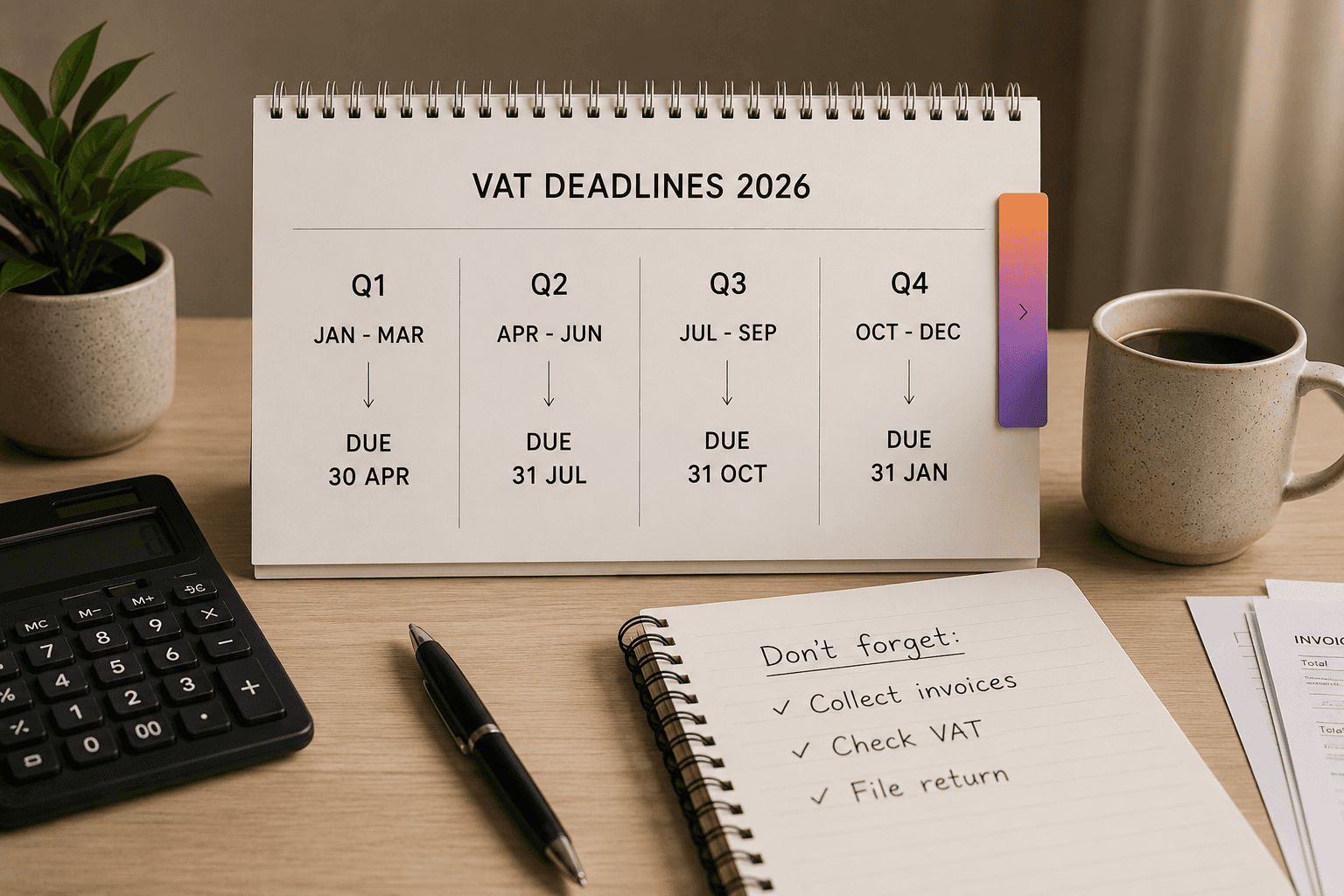
2026 quarterly VAT deadlines
Quarter | Period covered | Return & payment deadline |
Q1 2026 | January – March 2026 | 30 April 2026 |
Q2 2026 | April – June 2026 | 31 July 2026 |
Q3 2026 | July – September 2026 | 31 October 2026 |
Q4 2026 | October – December 2026 | 31 January 2027 |
In 2026, earlier payment dates apply for certain months because the filing deadline falls on a weekend. Always verify the exact payment date (as distinct from the filing date) for the relevant period, particularly for January, April and September 2026.
Monthly filers
Monthly VAT returns follow the same rule: due by the last day of the following month. If your January 2026 return is due, the deadline is 28 February 2026.
Annual filers
For the 2025 annual VAT return, it must be submitted no later than 31 March 2026, and any amount payable must be received by the Tax Authorities by that date.
After filing, you pay proactively. Unlike income tax, you do not receive a payment request or assessment after filing your VAT return. You are responsible for initiating the payment yourself by the deadline. This is an important operational detail that catches many first-time entrepreneurs off guard.
Do you need to file VAT with no turnover? Zero return
Yes. This also applies if you have not conducted any business in the Netherlands during that period. If you are VAT-registered and have an assigned filing period, you must file regardless of whether you generated any revenue or incurred any VAT-deductible costs during that period.
A zero return takes minutes to file via the Belastingdienst's entrepreneur portal (Mijn Belastingdienst Zakelijk). You simply enter zeros in all the relevant fields and submit. The obligation does not disappear because your business was inactive.
Why this matters: if you fail to file a zero return, the Belastingdienst will issue an estimated additional assessment (naheffingsaanslag) and a penalty, even though you technically owed nothing. This is entirely avoidable with a two-minute filing.
When do you NOT need to file VAT returns? KOR and exemptions
There are two main situations where you may be released from the periodic VAT filing obligation:
The Small Business Scheme (KOR, Kleineondernemersregeling)
The small businesses scheme is a VAT exemption for small businesses with turnover of at most €20,000 per calendar year. Your business must be established in the Netherlands. If you qualify and opt in, you stop charging VAT to customers, stop filing periodic VAT returns, and stop paying VAT to the Belastingdienst. The trade-off: you also cannot reclaim input VAT on any business expenses.
Key KOR facts for 2026:
Threshold: €20,000 annual turnover (excluding VAT)
Available to: all legal forms, sole traders, BVs, VOFs, foundations and associations
Application: voluntary you apply via Mijn Belastingdienst Zakelijk at least four weeks before the start of the next quarter
Since 2025: no mandatory three-year lock-in period; you can opt out more flexibly than before
If you exceed €20,000: you must deregister immediately, and from the first sale that pushed you over the limit, you must again charge and declare VAT
Is the KOR a good idea? It depends. The KOR works well for entrepreneurs with low business costs and predominantly private (B2C) clients. It is generally not attractive for BVs or businesses that invest heavily in equipment, software, or services because reclaiming input VAT on those investments would be worth more than the administrative simplification of the KOR. Most growing e-commerce and consulting BVs stay under the standard VAT regime for this reason.
VAT-exempt activities
Certain activities are entirely exempt from VAT regardless of turnover. These include most financial services, specific medical and healthcare services, education, and certain cultural activities. If your BV exclusively performs VAT-exempt activities, you may not need to register for VAT at all but you also cannot reclaim any input VAT on your costs. If in doubt, get a ruling from a tax advisor before assuming exemption applies.
VAT returns for international trade and cross-border services
If your business operates across borders selling to EU business clients, delivering digital services internationally, or importing goods, the VAT picture becomes more complex.
B2B services within the EU (reverse charge)
B2B (business-to-business) consulting within the EU often falls under the general rule: VAT is due where the customer is established, and the reverse charge may apply. Under the reverse charge mechanism, you issue an invoice without charging VAT, and the customer accounts for the VAT in their own country. You still report these transactions in your Dutch VAT return (in section 3b) and must also file an EU Sales Listing (Opgaaf ICP) a separate quarterly return that itemises intra-community transactions by customer VAT number.
B2C sales of goods to EU consumers (EU distance sales)
If you sell goods to consumers (B2C) where the goods are delivered in other EU countries, VAT is due in the EU country of arrival of the goods. This means you must charge local VAT on the sale, register for VAT in those EU countries, file VAT returns there, and pay VAT there.
The One-Stop Shop (OSS)
To avoid registering for VAT in every EU country where you have B2C sales, you can use the One-Stop Shop (OSS) scheme. With the OSS, you report the VAT due on B2C transactions in all other EU countries in a single quarterly OSS return and pay the VAT to the Dutch Tax Authorities, who then pass it on to the local authorities in the relevant EU countries.
Intrastat and EU Sales Listings
If you supply more than €50,000 in intra-community goods deliveries in a quarter, you must submit the EU Sales Listing every month for that quarter and the following four quarters. Below this threshold, quarterly EU Sales Listings suffice.
Cross-border VAT is an area where working with an experienced advisor before you start invoicing internationally is strongly recommended - the reverse charge rules, OSS registrations and Intrastat obligations are detailed and easy to get wrong.
What happens if you file VAT late?
Late filing and late payment are treated seriously in the Netherlands, and penalties increased significantly from 1 January 2025.
If you file your return late, the Belastingdienst may issue a notice of default (verzuimmededeling) or a formal penalty (boete). If they do not receive your return at all, they will issue an estimated additional assessment (naheffingsaanslag) based on their own estimate of what you owe.
If you file on time but pay late, you will get an additional assessment and a penalty for late payment (betaalverzuimboete) of 3% of the unpaid amount. The penalty is at least €50 and at most €6,709.
Corrections — the new 8-week rule: since 1 January 2025, entrepreneurs who discover they need to make a correction (because they processed more than €1,000 too much or too little VAT in previous returns) must now correct this within eight weeks. Failure to do so may result in a penalty of up to 100% of the VAT that was not (or would not have been) levied due to non-compliance.
Interest on late payment: in addition to penalties, the Belastingdienst charges belastingrente (tax interest) on late payments. Interest runs from the day after the deadline until the date full payment is received.
The practical takeaway: late filing is never worth the risk. A zero return takes two minutes. An estimated additional assessment and the process of disputing it takes considerably longer.
Common VAT mistakes and how to avoid them
These are the errors that come up most frequently with Dutch entrepreneurs, especially those in their first years of operation.
1. Not filing zero returns The most common mistake. If you had no activity in a period, you still file. Set a recurring calendar reminder for every filing deadline.
2. Using the wrong VAT rate The Netherlands operates three rates: 21% (standard), 9% (reduced applied to food, books, medicines, hotel accommodation until 2026), and 0% (exports and certain cross-border B2B services). Misapplying these rates leads to under- or over-declaration. Note: from 1 January 2026, the reduced rate for accommodation (hotels, holiday rentals) has been abolished, these now attract the 21% standard rate.
3. Missing the payment deadline after filing Filing your return on time does not mean you've met your obligation. Payment must also arrive at the Belastingdienst by the same deadline. Initiate your bank transfer early enough to account for processing time.
4. Forgetting to report reverse-charge transactions If you buy services from a foreign supplier (e.g. a software subscription from a US company, or a service from an EU consultant), the reverse charge often applies — meaning you need to declare both the VAT you notionally "paid" and then reclaim it in the same return. Many entrepreneurs skip this because no money actually changes hands, but omitting it is technically incorrect.
5. Waiting too long to correct errors Smaller errors under €1,000 may be corrected in the next declaration. For larger differences (above €1,000), you need to file a supplementary declaration. Since 2025, you have eight weeks from discovery to correct not the vague "as soon as possible" of previous years. Act quickly.
6. Mishandling the KOR transition Joining or leaving the KOR triggers revision obligations on previous VAT claims. If you claimed VAT back on a business purchase and then join the KOR, you may need to repay part of that VAT. Always get advice before switching in or out of the KOR.
7. Not keeping records for the required period You are generally required to keep VAT records for seven years. For immovable property (real estate), the retention period is ten years. A VAT audit can cover up to five previous fiscal years.
Should you outsource or automate VAT filing?
For many entrepreneurs, the recurring quarterly deadline is manageable, especially if your transactions are straightforward. But as your business grows, the complexity grows with it: multiple VAT rates, cross-border clients, OSS registrations, reverse charge transactions, and tight correction deadlines all add up.
There are broadly three approaches:
DIY via the Belastingdienst portal You log into Mijn Belastingdienst Zakelijk with eHerkenning (for BVs and VOFs) or DigiD (for sole traders), fill in the return manually, and submit. This works fine for simple businesses with domestic-only clients and consistent transaction volumes. The risk is human error and missed deadlines when you're busy.
Bookkeeping software with VAT automation Platforms that connect to your bank and automate transaction categorisation can pre-populate your VAT return with the correct figures. This significantly reduces the manual effort and error risk but you still need to review and submit, and the software is only as good as the data that goes into it. Miscategorised transactions produce incorrect VAT returns.
Outsource to an accountant or full-service finance partner A qualified accountant handles your VAT filings as part of your broader financial administration, ensuring returns are filed on time, rates are correctly applied, cross-border transactions are handled properly, and corrections are made within the eight-week window if needed. For BVs, this also integrates with your corporate tax filing and annual accounts.
The right answer depends on your transaction volume, the complexity of your business model (especially international), and how much of your time you want to spend on financial administration rather than running your company.
At Neno, we combine AI-driven bookkeeping automation with chartered accountants who handle your VAT filings, tax returns, and financial administration end to end, so deadlines are never missed and you always have a real person to call when something doesn't look right. If you're spending more than an hour per quarter on VAT alone, it's worth having a conversation.
Get in touch with Neno to see how we handle VAT for Dutch BVs and growing SMEs.
This article reflects the rules and thresholds applicable in 2026. VAT legislation changes annually. Always consult a qualified tax advisor for advice specific to your situation.

Written by
Nick Knuppe
CEO & Founder