Automation
BV or sole proprietorship: which legal structure fits your business?
Find out whether a BV or sole proprietorship fits your business. Clear comparison of taxes, costs, and liability.
•
12 min
Intro
As an entrepreneur in the Netherlands, you will face the choice between a sole proprietorship and a BV. It is not a minor decision. It directly affects how much tax you pay, how much personal risk you carry, and how much time you spend on administration.
There is no standard answer. What works well for one business may be unnecessarily costly or restrictive for another. The difference mainly comes down to a few factors: your profit, your risk, and how you plan to grow. Once you understand these, it becomes much easier to choose a legal structure that fits your situation.
(This article is written for Dutch entrepreneurs and freelancers operating in the Netherlands.)
What is a sole proprietorship and what is a BV?
Before comparing the two legal structures, it is important to understand what they actually are.
What is a sole proprietorship?
A sole proprietorship is the simplest legal structure in the Netherlands. As a sole proprietor, you are legally the business. There is no distinction between your private assets and the assets of the business. You are the sole owner and carry full responsibility, but you also keep all the profits your business generates. Many freelancers (self-employed without staff) operate as a sole proprietorship because it is quick and inexpensive to set up through the Dutch Chamber of Commerce.
What is a BV?
A private limited company (BV) is a legal entity. This means the BV exists separately from you as a person. The company’s capital is divided into shares. As a director-major shareholder (DGA), you are employed by your own BV and pay yourself a salary. The BV has its own rights and obligations, and in most cases you are not personally liable for its debts.
What is the difference between a freelancer and a BV?
Technically, “freelancer” is not a legal structure but a way of working. It means you operate as a self-employed professional without employees. As a freelancer, you can operate either as a sole proprietorship or through a BV. The most common setup for starters is a sole proprietorship, but as a business grows, a BV often becomes more attractive. In this article, we use “sole proprietorship” and “freelancer” interchangeably when referring to the legal structure.
Key differences between a BV and a sole proprietorship
The choice between a BV and a sole proprietorship comes down to three main factors: liability, taxation, and administrative complexity. Below is a concise overview of the key differences.
Feature | Sole proprietorship | BV |
|---|---|---|
Legal entity | No | Yes |
Personal liability | Full | Limited |
Type of tax | Income tax | Corporate + income tax |
Tax deductions | Self-employed deduction, SME profit exemption | No entrepreneurial deductions |
Mandatory salary | No | Yes (customary salary: min. €58,000 in 2026) |
Setup costs | Low (Chamber of Commerce registration) | Higher (notary required) |
Administrative obligations | Limited | More extensive (annual accounts filed with Chamber of Commerce) |
Attracting investors | More difficult | Easier through share structure |
In short, a sole proprietorship is simpler and cheaper, but offers less protection and becomes less tax-efficient at higher profit levels. A BV is more complex, but provides better personal protection and can offer tax advantages as profits increase.
Taxes: when is a BV more tax-efficient?
One of the most common questions is: which is more advantageous, a BV or a sole proprietorship? The answer largely depends on your level of profit.
Income tax for a sole proprietorship
As a self-employed entrepreneur with a sole proprietorship, you pay income tax (Box 1) on your net earnings. In 2026, the rates range from 35.75% on taxable income up to around €38,000, to 37.56% between €38,000 and €78,000, and up to 49.50% above that.
This may seem high, but a sole proprietorship qualifies for several tax deductions that can significantly reduce your taxable profit:
Self-employed deduction: €1,200 (2026)
SME profit exemption: 12.70% of profit (after deductions)
Starter’s deduction in the first three years
These deductions make a sole proprietorship particularly tax-efficient at lower profit levels.
Taxes for a BV
A BV pays corporate income tax (CIT) on its profits: 19% on the first €200,000 and 25.8% on amounts above that.
As a director-major shareholder (DGA), you also pay income tax on your mandatory salary (Box 1). If you distribute profits as dividends, you pay tax in Box 2. In 2026, the Box 2 rate is 24.5% up to €68,843 and 31% above that.
A BV does not qualify for the entrepreneurial tax deductions available to sole proprietorships. At lower profit levels, this can make a BV less tax-efficient.
Example: €150,000 profit
Assume you generate €150,000 in profit.
With a sole proprietorship, you pay income tax after deductions, but a significant portion of your income may fall into the highest tax bracket, resulting in a relatively high overall tax burden.
With a BV, you first pay 19% corporate tax on €150,000, which equals €28,500. You then pay Box 2 tax if you distribute the remaining profit as dividends. Depending on your DGA salary and personal situation, the total tax burden may be lower.
The exact outcome varies by case. The balance between salary and dividends plays an important role, so it is advisable to have this calculated by a tax advisor.
From what profit level is a BV worthwhile?
This is one of the most practical questions for any entrepreneur considering a move to a BV.
The tax tipping point, where a BV becomes more advantageous than a sole proprietorship, shifts each year due to changes in tax rates and deductions. In 2026, this point is around €93,000 in profit (before salary or dividend), assuming a standard DGA salary of €58,000.
For comparison, in previous years this threshold was closer to €200,000. The decrease is mainly due to the reduction of the self-employed deduction, which has made sole proprietorships less tax-efficient than before.
Rules of thumb:
Below €93,000 profit: a sole proprietorship is usually more tax-efficient
Between €93,000 and €200,000: a BV becomes more attractive, depending on your situation
Above €200,000: a BV is generally more tax-efficient
Keep in mind that the exact tipping point depends on factors such as your salary, available deductions, and personal circumstances. It is advisable to consult an expert before making the switch.
Liability: risks of both legal structures
Liability is a key reason for many entrepreneurs to choose a BV.
Personal liability in a sole proprietorship
As the owner of a sole proprietorship, you are fully personally liable for the debts of your business. There is no legal separation between your private assets and your business assets.
If your business cannot meet its obligations, creditors may claim your personal assets, such as your home, car, or savings. If you are married under certain conditions, this may offer some protection. Otherwise, your partner’s assets may also be at risk.
Limited liability in a BV
A BV works differently. Because it is a legal entity, there is a separation between you as a person and the company. In principle, the BV is responsible for its own debts, not you personally. Your private assets are generally protected.
There are exceptions. You may still be held personally liable in cases such as:
Improper management or serious negligence
Entering into obligations while knowing the BV could not meet them
Providing personal guarantees to creditors
For many entrepreneurs, especially in higher-risk industries, this limitation of liability is a major reason to choose a BV.
Costs and administration compared
The financial and administrative burden of a BV is significantly higher than that of a sole proprietorship. This should be part of your decision.
Cost of starting a sole proprietorship
Setting up a sole proprietorship is simple and accessible. You register with the Dutch Chamber of Commerce and can start immediately. No notary is required.
Ongoing administration is also limited. You maintain your bookkeeping and file income tax and VAT returns. This makes it an attractive option for starting entrepreneurs.
Cost of setting up a BV
A BV requires a notarial deed. Setup costs vary, but you should expect at least several hundred euros, and more if customized articles are needed.
In addition, there are ongoing annual costs:
Payroll administration for the DGA salary
Preparing and filing annual accounts with the Chamber of Commerce
Corporate income tax filings
Possible dividend tax filings
Higher accounting or advisory costs
Annual administrative costs for a BV are typically €1,000 to €3,000 higher than for a sole proprietorship. This is an important threshold, especially if your profit is not far above the tipping point.
Administration: sole proprietorship vs. BV
The administration of a sole proprietorship is relatively simple. You report directly to the tax authorities and manage your own records.
A BV has stricter requirements. You must prepare and file annual accounts and other financial documents. The level of detail depends on the size of the company.
In practice, a BV requires more structure and administrative discipline, often with greater reliance on an accountant or bookkeeper.
When should you switch from a sole proprietorship to a BV?
For many entrepreneurs, moving from a sole proprietorship to a BV is a major milestone. The question is when the timing is right.
Signs it may be time for a BV
Your profit is approaching or exceeding €93,000, the 2026 tax tipping point
You face increasing business risks, such as large contracts, supplier credit, or operational liability
You want to protect your personal assets, such as your home or savings
You plan to attract investors, as a BV makes issuing shares and raising capital easier
You want to retain profits within the company instead of paying income tax immediately
You operate in a higher-risk industry, such as construction, technology, or international trade
Three ways to convert a sole proprietorship into a BV
There are three legal routes to make the transition:
Silent transfer (tax-neutral conversion)
You transfer your sole proprietorship into a BV without immediate tax settlement. The BV continues with the book values of the business. This is often the most tax-efficient option, but it comes with conditions, such as maintaining the BV for at least three years.
Asset transfer (taxable conversion)
You set up a BV and sell your sole proprietorship to it. For tax purposes, this is treated as ending your business, which means you pay income tax on the cessation profit, including hidden reserves and goodwill. If you file a letter of intent before April 1, the conversion can take effect retroactively from January 1. Part of the tax burden may be reduced through specific reliefs.
Share transaction or sale
Less common, but relevant in certain situations.
Always consult a tax advisor or accountant before making this move. The right approach depends on your personal situation, any hidden reserves, and your future plans.
Advantages and disadvantages of both options
To make the choice clearer, here is a summary of the main pros and cons.
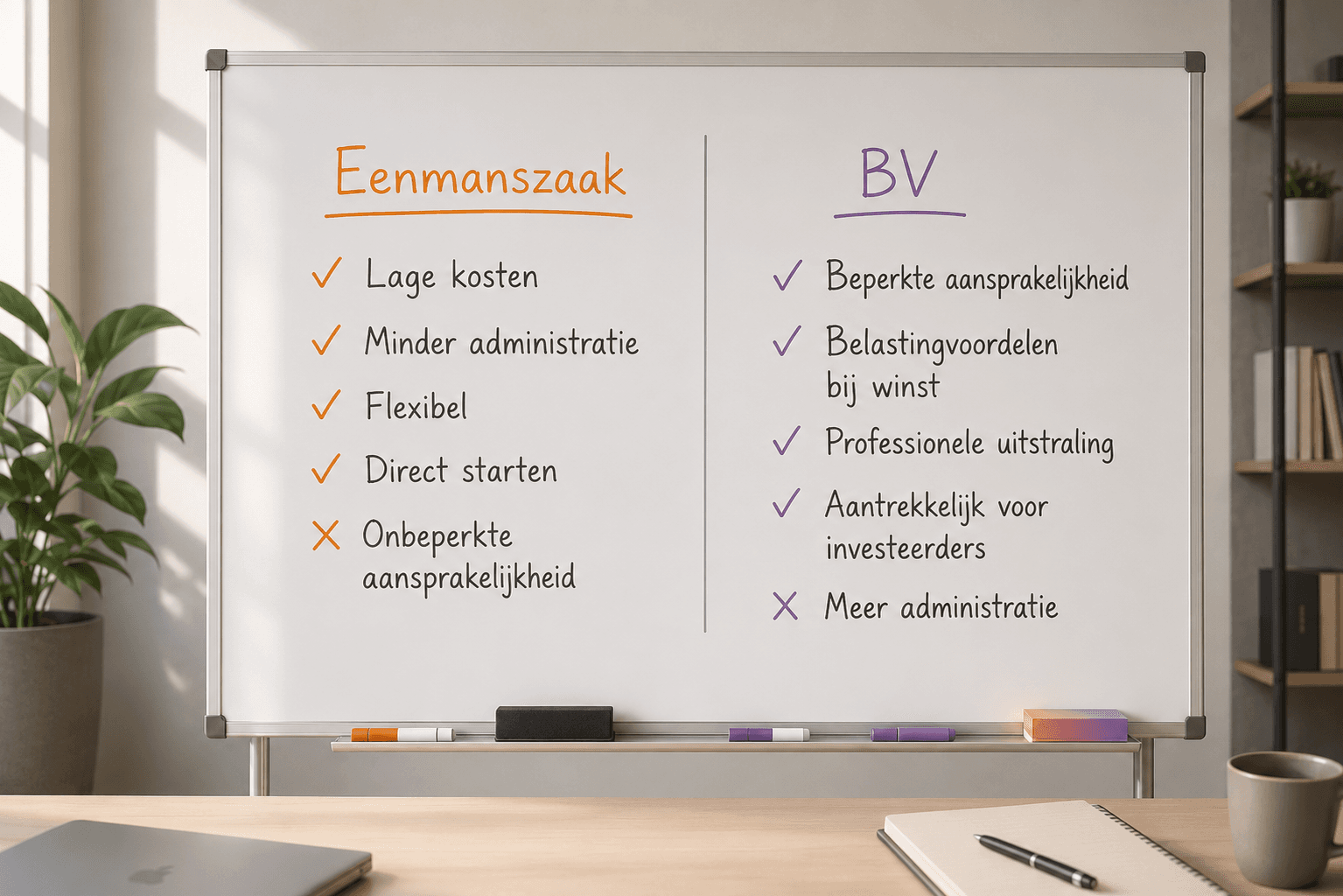
Advantages of a sole proprietorship
Easy and inexpensive to set up, no notary required
Access to tax deductions such as the self-employed deduction and SME profit exemption
Limited administrative requirements, no mandatory annual accounts filing
Full control, no shareholders involved
Well suited for starting entrepreneurs and lower profit levels
Disadvantages of a sole proprietorship
Full personal liability, your private assets are not protected
Higher tax burden at higher profits, up to 49.5% in Box 1
Less professional perception for large clients or investors
Limited growth options, no share structure
Advantages of a BV
Limited liability, your personal assets are generally protected
More tax-efficient at higher profits due to lower corporate tax rates
Ability to retain profits within the company
More professional image for investors and larger clients
Easier to attract investors through shares
Flexibility in balancing salary and dividends
Disadvantages of a BV
Higher setup and administrative costs
Mandatory DGA salary of at least €58,000 (2026), even if profits are lower
More administrative obligations, including annual accounts and corporate tax filings
No access to self-employed tax deductions
More complex accounting requirements
Less attractive at lower profit levels due to fixed costs
Which structure fits your situation?
The choice between a BV and a sole proprietorship depends on three key factors: your profit, your risk profile, and your growth ambitions.
Choose a sole proprietorship if:
You are just starting and your revenue is still uncertain
Your profit is consistently below €93,000 per year
Your business carries limited financial risk
You want to keep administrative work to a minimum
Choose a BV if:
Your profit is approaching or exceeding €93,000
You want to protect your personal assets
You operate in a higher-risk industry
You want to attract investors or sell your business
You want to retain profits within the company and defer taxes
If you want more clarity on the financial choices for your business, Neno combines automated bookkeeping with personal advice from certified accountants. Whether you run a sole proprietorship or are considering a BV, the goal is to help you stay in control of your finances so you can focus on running your business.
Feel free to get in touch with Neno to explore which structure fits your situation best.
This article is based on the most up-to-date information for 2026. Tax rates and thresholds may change each year. Always consult a tax advisor or accountant for advice tailored to your situation.

Written by
Nick Knuppe
CEO & Founder