Bookkeeping
Payroll
DGA salary vs dividend in a Dutch BV: what is the smartest strategy?
Salary or dividend in your Dutch BV? Discover the smartest way to pay yourself while managing tax, cash flow and long-term growth.
•
23 min
Intro
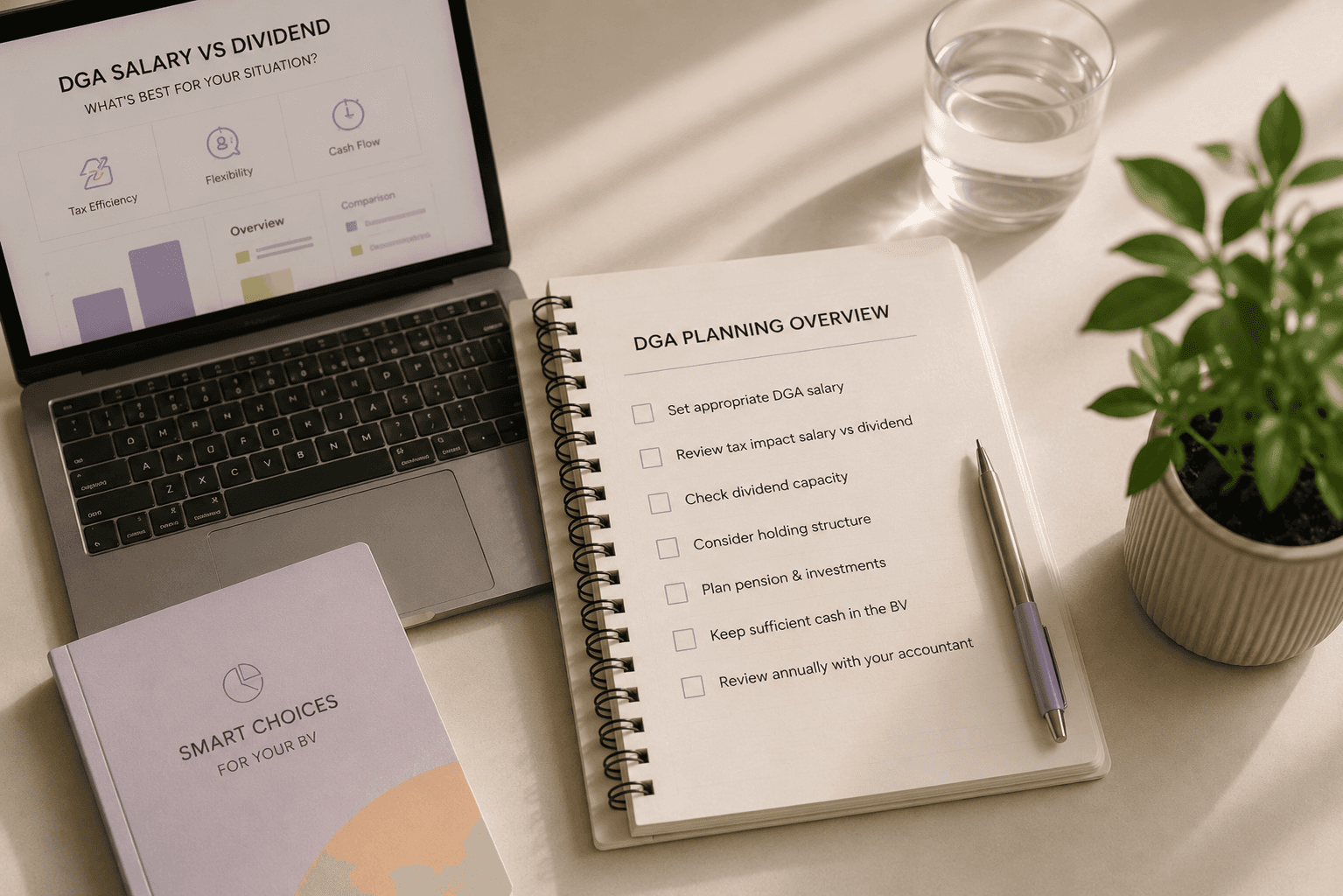
If you own and manage a Dutch BV, one of the most important financial questions is how you should pay yourself. Should you take more salary, distribute dividends, or use a mix of both? At first glance, dividends may look more attractive because salary can be taxed at high income tax rates. In practice, the answer is more nuanced because Dutch tax rules require most director-shareholders to pay themselves a minimum salary before relying on dividends.
The difference matters for cash flow, tax planning, payroll obligations, mortgage eligibility, pension planning and the long-term structure of your company. In 2026, the minimum DGA salary is €58,000, and dividend taxation still follows the box 2 system with two rates: 24.5% up to €68,843 and 31% above that amount. A smart strategy is therefore not simply “salary or dividend”, but choosing the right combination for your company’s profit level, growth plans and personal situation.
What Is a DGA and How Are You Paid in a Dutch BV?
A DGA is a director-major shareholder of a Dutch BV. In practical terms, this usually means that you both work for the company and own a significant shareholding in it. Because you are on both sides of the relationship, as director and shareholder, Dutch tax law treats your pay differently from that of a normal employee or passive investor.
There are two main ways to extract money from your BV: salary and dividend. Salary is compensation for the work you perform as director and is taxed in box 1 as employment income. Dividend is a distribution of after-tax profit to shareholders and is taxed through the corporate tax and box 2 system. Understanding the difference is essential because each route has different tax, compliance and planning consequences.
What counts as DGA salary?
DGA salary is the wage you receive for the work you perform for your BV. The company processes it through payroll, withholds wage tax where required and records the salary as a deductible business expense for corporate income tax purposes.
This is why salary reduces the taxable profit of the BV. At the same time, it creates personal taxable income for you in box 1, where rates can be significantly higher than corporate tax rates.
What counts as dividend?
Dividend is a distribution of profit to shareholders. It can only be paid from available equity after the BV has made profit, paid corporate income tax and passed the required dividend distribution checks.
Unlike salary, dividend is not deductible for the BV. The company first pays corporate income tax on its profit. After that, the shareholder pays box 2 tax on the dividend distribution.
Why the distinction matters
The distinction matters because salary and dividend are taxed in different systems. Salary affects payroll, social security position, pension base and personal income. Dividend affects retained earnings, shareholder returns and box 2 taxation.
A founder who only looks at the headline tax rate may choose the wrong route. The better approach is to compare the full combined tax burden and the practical consequences.
How the Minimum DGA Salary Rule Works in the Netherlands in 2026
The Dutch minimum salary rule is known as the gebruikelijk loonregeling. It exists because a DGA could otherwise keep salary artificially low and extract most income as dividends, which may lead to a lower overall tax burden. The rule requires a DGA to receive a salary that is considered normal for the work performed.
For 2026, the standard minimum amount is €58,000. However, that is not always the final answer. The usual salary must be set at the highest of three reference points: the salary from the most comparable employment, the salary of the highest-paid employee within the company or connected companies, and the statutory minimum amount of €58,000. The 100% comparable salary rule has applied since 2023, meaning the previous margin has been removed.
The €58,000 minimum
The €58,000 amount is the statutory benchmark for 2026. If your comparable market salary is lower and you can substantiate that, a lower amount may sometimes be acceptable. But the starting point for most dgas is that the salary cannot simply be set below this level without a defensible reason.
The three-factor rule
The salary must generally be at least the highest of:
the salary for the most comparable employment
the salary of the highest-paid employee in your bv or connected companies
€58,000 in 2026
This means that a profitable bv with employees or a founder performing high-level executive work may need to pay more than €58,000.
Who sets the amount?
The amount is set by law and updated periodically. The Belastingdienst can challenge a salary that is too low if it does not reflect the work performed. That is why dgas should review their salary annually, especially when profit, team size or responsibilities change.
How DGA Salary Is Taxed in the Netherlands
Salary paid to a dga is taxed as employment income in box 1. That means it follows the Dutch income tax brackets and payroll tax rules. For 2026, income tax rates run up to 49.5% for higher incomes, which makes salary expensive at the top end.
At the same time, salary is deductible for the bv. This means every euro of salary reduces the company’s taxable profit before corporate income tax. The tax planning question is therefore not just what you personally pay, but what happens across both the company and the shareholder.
Income tax on salary
DGA salary is taxed progressively. Lower income is taxed at lower rates, while higher income falls into higher brackets. In 2026, the top bracket applies above €78,426 and is taxed at 49.5%.
Because of this progressive system, taking a very high salary can become less efficient than leaving profit in the bv or distributing it later as dividend.
Payroll obligations
A bv that pays salary must run payroll correctly. This means calculating wage tax, filing payroll returns and making timely payments to the Belastingdienst. Even when the dga is the only employee, the payroll administration still needs to be handled properly.
Net effect on take-home pay
The net amount you receive from salary depends on your gross salary, applicable tax credits, personal situation and any pension or benefit arrangements. Salary gives predictable monthly income, but the tax burden can be high when it exceeds the lower brackets.
How Dividend Is Taxed in a Dutch BV in 2026
Dividend is taxed in two layers. First, the BV pays corporate income tax on its profit. In 2026, the corporate income tax rate is 19% on taxable profit up to €200,000 and 25.8% on profit above that threshold. After corporate tax, the remaining profit can potentially be distributed as dividend.
The shareholder then pays box 2 tax on the dividend. In 2026, box 2 is taxed at 24.5% up to €68,843 and 31% above that amount. The result is a combined tax burden that depends on the corporate tax bracket and the box 2 bracket.
Corporate tax first
Before dividend can be paid, the BV must first calculate and pay corporate income tax on its taxable profit. This is why dividend is paid from after-tax profit.
If your BV makes €100,000 profit before dividend and no further adjustments apply, it first pays corporate tax. Only the remaining profit is available for distribution, subject to legal and financial checks.
Box 2 tax after distribution
Once dividend is distributed to an individual shareholder with a substantial interest, the dividend falls into box 2. The lower 24.5% rate applies up to the first bracket threshold, and the 31% rate applies above that.
When dividend becomes available
Dividend can only be paid if the BV has sufficient distributable reserves and passes the required balance sheet and distribution tests. Paying dividend when the company cannot meet its obligations can create director liability risks.
DGA Salary vs Dividend: Side-by-Side Tax Comparison
The simplest way to compare salary and dividend is to look at the total tax burden across the company and the individual shareholder. Salary is taxed in box 1 but deductible for the BV. Dividend is not deductible, but it is taxed after corporate income tax and then in box 2.
This means the best route depends on profit level, the required minimum salary, whether the BV is in the 19% or 25.8% corporate tax bracket, and whether dividend falls into the lower or higher box 2 bracket. A single rule of thumb is not enough.
Example 1: profit up to €200,000
If the BV is taxed at 19% corporate tax and dividend falls into the lower box 2 rate, the combined tax burden on distributed profit is roughly 38.8%. This is calculated as 19% corporate tax first, followed by 24.5% box 2 tax on the remaining 81%.
That can be lower than the top box 1 salary rate. However, the minimum salary rule prevents a DGA from simply taking all income as dividend.
Example 2: dividend above the lower box 2 bracket
If the bv pays 19% corporate tax and the shareholder pays 31% box 2 tax on the dividend, the combined burden is roughly 44.1%. That is still below the 49.5% top salary rate, but the difference is smaller.
Example 3: profit above €200,000
For profit taxed at 25.8% corporate tax, the combined tax burden becomes higher. With 24.5% box 2 tax, the combined burden is roughly 44.0%. With 31% box 2 tax, it is roughly 48.8%.
At that point, the difference between salary and dividend becomes much narrower, especially after considering pension, benefits and timing.
Why the Dutch Tax Authority Limits Your Dividend Strategy
Many founders prefer dividends because dividends can feel more tax efficient and flexible. You can choose when to distribute them, and they do not require monthly payroll in the same way salary does. That makes dividend planning attractive, especially for profitable BV owners.
The Belastingdienst limits this strategy through the minimum salary rule. Without it, a DGA could pay themselves a very low salary and convert work income into dividend income. The usual salary rule is designed to prevent that type of tax arbitrage.
Anti-avoidance logic
The logic is simple: if you work for your BV, you should receive a salary that reflects that work. Only after that does dividend become the route for distributing shareholder profit.
Enforcement trends
The Belastingdienst can ask for support if your salary appears too low compared with your role, profit level or employees. This is why it is important to document the reasoning behind a lower salary or any exception.
Why dividend still matters
The minimum salary rule does not make dividends irrelevant. It simply means dividends are usually part of the strategy after an appropriate salary has been set.
The Optimal Mix: How to Balance Salary and Dividend in a Dutch BV
For many DGAs, the smartest strategy is a balanced approach. You pay a salary that satisfies the usual salary rule, then consider whether remaining profits should stay in the company, move to a holding or be distributed as dividend.
This decision should be reviewed annually. Profit, tax rates, personal cash needs, investment plans and pension strategy can all change. What is optimal in year one may not be optimal in year three.
Set salary at a defensible level
Many DGAs start with the minimum or a substantiated lower salary if the company cannot support the standard amount. The key is that the amount must be defensible under the rules.
Use dividend for excess profit
Once salary and business needs are covered, dividend can be used to distribute surplus profit. This is usually more relevant for profitable companies with stable cash flow.
Keep enough cash in the BV
Taking too much dividend can weaken the company. Before paying dividend, you should consider working capital, upcoming taxes, payroll, investment plans and creditor protection.
Review annually with an accountant
A good accountant will review salary, dividend capacity, corporate tax, box 2 exposure and cash needs together. This prevents isolated decisions that look efficient in one tax category but create problems elsewhere.
Using a Holding BV to Optimize Salary and Dividend
Many Dutch entrepreneurs use a holding structure: a personal holding owns shares in the operating BV. The operating BV runs the business, while the holding receives dividends, holds retained profits and may own other investments or subsidiaries.
This structure can be useful, but it is not automatically necessary for everyone. It makes the most sense when there is meaningful profit, exit potential, multiple business activities, asset protection goals or a long-term reinvestment strategy.
Holding versus operating BV
The operating BV carries out the business activities and takes commercial risk. The holding BV sits above it and owns the shares. Profits can often be moved from the operating BV to the holding as dividend under the participation exemption if conditions are met.
Participation exemption
The participation exemption can allow qualifying dividends and capital gains received by the holding from the operating BV to be exempt from corporate income tax at holding level. This is one of the main reasons founders use holding structures.
Deferring box 2 tax
If profits are distributed from the operating BV to the holding, the individual shareholder does not necessarily pay box 2 tax immediately. Box 2 tax generally becomes relevant when money is distributed from the holding to the individual.
When this makes sense
A holding structure can make sense if you want to retain profits for future investments, separate business risk from accumulated wealth or prepare for a future sale. For very small companies, the extra cost and administration may outweigh the benefit.
DGA Salary and Dividend for Startups With Low Revenue
Startups often do not have enough revenue to pay the full standard DGA salary. Dutch rules recognize that a rigid salary requirement can be unrealistic for early-stage companies, especially when the business is not yet profitable.
In those cases, it may be possible to use a lower salary, but it must be justified. The fact that the founder wants to preserve cash is not always enough by itself. The bv must be able to show that the lower salary fits the financial position and stage of the company.
Startup exception
A startup or loss-making BV may be able to apply a lower salary if the company does not have enough cash to pay the standard amount. In some cases, consultation with the Belastingdienst or proper documentation is advisable.
Zero payroll filing
If no salary is paid, the payroll position still needs to be handled correctly. A BV should not simply ignore payroll obligations. Depending on the situation, payroll filings or formal setup may still be required.
When dividend is not an option
Dividend is usually not available when the company has no distributable profit or insufficient equity. A startup that has not yet generated retained earnings generally cannot replace salary with dividend.
Building retained earnings first
For many startups, the priority is to reinvest cash, build revenue and create retained earnings. Dividend planning becomes more relevant once the company is stable and profitable.
Social Security and Benefits: Salary vs Dividend
The difference between salary and dividend is not only about tax. Salary can affect practical life decisions such as getting a mortgage, building pension rights and qualifying for certain income-based arrangements. Dividend may be tax-efficient in some cases, but it does not always provide the same financial profile.
This is why the lowest-tax route is not always the best personal strategy. A founder who wants to buy a house, build pension income or show stable income may need a different mix than a founder focused purely on retaining capital in the company.
Mortgage eligibility
Lenders often look at salary and stable income when assessing borrowing capacity. Dividend may be considered, but it is typically less predictable than salary and may be treated differently by lenders.
Allowances and income-based effects
Salary affects taxable income in box 1 and may influence eligibility for income-dependent allowances or contributions. Dividend affects box 2 and can also influence the broader tax picture.
What dividend does not give you
Dividend does not function like employment income. It does not create the same payroll base, pension base or monthly income profile. That can matter more than founders expect.
Pension Planning for DGA: Salary or Dividend?
For DGAs, pension planning should be part of the salary versus dividend decision. Salary can create a basis for pension accrual and retirement planning, while dividend is investment income and does not automatically build pension rights.
A founder who takes only the minimum salary and distributes the rest as dividend may have good short-term cash efficiency, but still needs a separate retirement strategy. This is especially important for entrepreneurs who do not build pension through a normal employer scheme.
Pension linked to salary
Many pension arrangements are linked to salary. A higher salary can create more room for pension accrual, depending on the chosen setup and applicable rules.
Third-pillar options
DGAs can also use third-pillar pension tools, such as annuity products. These can be useful when traditional employer pension accrual is limited.
Dividend and retirement planning
Dividend can support wealth building, but it is not the same as pension planning. If dividend is used as part of long-term wealth strategy, it should be coordinated with investments, holding structure and personal tax planning.
FAQs: DGA Salary vs Dividend in a Dutch BV
Can you skip salary entirely?
Usually not if you work for your BV. The usual salary rule requires a defensible salary. Exceptions may apply for low-revenue or loss-making companies, but they must be properly documented.
What if the BV has no profit?
If the BV has no profit and insufficient cash, a lower salary may be possible. Dividend is generally not available if there are no distributable profits.
Can a partner also receive dividend?
A partner can receive dividend if they are a shareholder and a valid dividend distribution is made. If they work for the BV, salary rules may also become relevant depending on their role and shareholding.
Is dividend better than salary above €58,000?
Often dividend can be more tax-efficient than high additional salary, especially when the BV is in the lower corporate tax bracket and dividend falls in the lower box 2 bracket. But the answer depends on profit, cash flow, personal needs, pension planning and compliance.
How Neno helps with DGA salary and dividend planning
Choosing between salary and dividend is not a one-time decision. It affects payroll, corporate tax, box 2 planning, cash flow, pension strategy and the long-term structure of your BV. At Neno, we help Dutch BV founders and growing companies manage that full picture instead of looking at salary or dividend in isolation.
Neno brings together business banking, bookkeeping, payroll, VAT, tax and financial administration in one environment. If you want to pay yourself from your BV in a way that is compliant, tax-aware and aligned with your personal goals, Neno helps you build the right setup from day one.

Written by
Nick Knuppe
CEO & Founder