Bookkeeping
Accounting
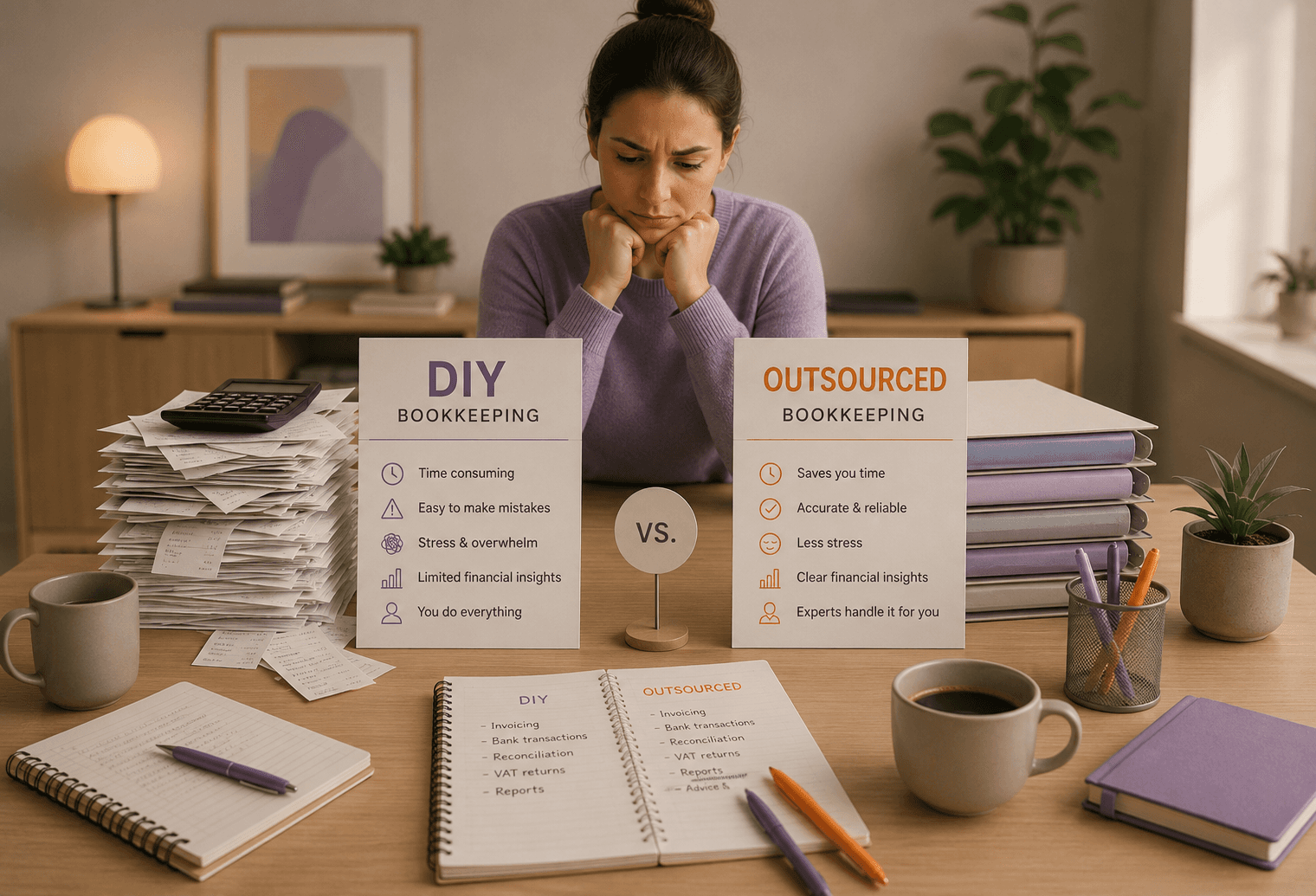
DIY vs. outsourced bookkeeping: an honest comparison for Dutch entrepreneurs
Should you do your own bookkeeping or outsource it in the Netherlands? Compare the real costs, compliance risks, AI bookkeeping platforms, and the best option for Dutch BV founders and entrepreneurs.
•
19 min
Intro
Most entrepreneurs approach bookkeeping as a simple cost decision. Either you pay a bookkeeper every month or you do it yourself and save money. On paper, the comparison looks straightforward. A bookkeeping subscription costs €20 per month, while a professional bookkeeping service for a BV can easily cost several hundred euros monthly. The conclusion seems obvious.
In practice, the real question is rarely about visible cost alone. It is about time, compliance risk and the hidden financial consequences of mistakes. Dutch bookkeeping is tightly connected to VAT returns, payroll taxes, annual accounts, KvK filing obligations and corporate income tax. Errors in one area often spread into several others. A founder spending ten hours per month on administration at an implicit business value of €80 per hour is already “paying” €800 monthly in opportunity cost before considering penalties, missed deductions or audit exposure. That is why the DIY versus outsourcing decision deserves a more honest analysis than the generic pro-and-con lists most articles provide.
The Real Question Is Not Cost. It Is Risk and Time.
The most important shift in perspective is understanding that bookkeeping is not merely administrative work. It is a compliance system tied directly to Dutch tax law and corporate obligations.
The complexity changes dramatically depending on your legal structure. A freelancer with a simple sole proprietorship has very different obligations from a BV with payroll, dividends and annual filing requirements. Your choice between DIY bookkeeping and outsourcing should therefore begin with your structure, not your software budget.
The difference between a BV or sole trader directly determines the compliance burden you carry.
A founder billing clients at €80 per hour who spends 8 to 12 hours monthly on bookkeeping is effectively spending:
Hours per month | Implicit annual cost |
6 hours | €5,760 |
10 hours | €9,600 |
12 hours | €11,520 |
That hidden cost is often far higher than professional bookkeeping support.
The risk dimension matters just as much. Dutch bookkeeping supports:
Quarterly VAT returns
Corporate income tax filings
Payroll tax submissions
Annual account preparation
KvK filing obligations
DGA salary administration
WKR administration
A recent KvK survey from April 2026 found bookkeeping confusion and tax assessment mistakes among the most common early-stage problems reported by Dutch entrepreneurs.
DIY bookkeeping is not inherently wrong. For some founders it is genuinely the best choice. But it should be approached with realistic expectations about time consumption, compliance exposure and scalability.
What Dutch Bookkeeping Actually Involves: The Full Scope
Many entrepreneurs underestimate what a complete Dutch bookkeeping process actually includes. It is far more than uploading receipts into software.
At minimum, a compliant bookkeeping process requires continuous administration throughout the year. Once employees, payroll or a BV structure enter the picture, the workload increases quickly.
Core bookkeeping responsibilities
Recording incoming invoices
Recording outgoing invoices
Bank reconciliation
VAT preparation and filing
Payroll administration
Loonheffingen filings
Depreciation tracking
Accruals and provisions
Year-end closing
Annual accounts preparation
KvK filing compliance
Quarterly VAT returns alone already create recurring compliance deadlines. Entrepreneurs must know exactly when to file VAT.
For BVs, the obligations extend further:
BV-specific obligations | Required |
DGA payroll | Yes |
Annual accounts | Yes |
Shareholder adoption | Yes |
KvK filing | Yes |
Dividend documentation | Often |
WKR administration | Often |
The annual accounts themselves include a profit and loss statement, balance sheet and explanatory notes. Preparing a compliant balance sheet Netherlands structure correctly is already more technical than many founders initially expect.
All records must generally be retained for at least 7 years. Real-estate related records often require 10 years of retention.
DIY Bookkeeping in the Netherlands: The Honest Advantages
DIY bookkeeping has real advantages. Dismissing it entirely would be intellectually dishonest.
Founders who manage their own administration usually develop much stronger financial awareness than founders who delegate everything immediately. They know their cash position. They understand which clients pay late. They see margins changing in real time.
That visibility can genuinely improve business decision-making.
The cost savings are also real for simple businesses.
Typical DIY software costs
Software type | Monthly cost |
Basic bookkeeping software | €10 to €20 |
Mid-market platforms | €20 to €50 |
For a solo ZZP entrepreneur with predictable invoices and low transaction volume, this can absolutely make sense.
Other practical advantages include:
Immediate access to financial data
Full internal control
No dependency on external responsiveness
Greater confidentiality
Faster invoice and payment monitoring
Some founder personalities simply prefer maintaining direct control over financial administration. For disciplined operators with simple structures, DIY bookkeeping can remain viable for years.
The Hidden Costs and Risks of DIY Bookkeeping
The visible software subscription is only a small part of the actual cost equation.
The biggest hidden cost is time.
A small Dutch BV with DGA payroll typically requires:
Business type | Monthly bookkeeping time |
Simple ZZP | 3 to 6 hours |
Small BV with DGA | 8 to 12 hours |
BV with employees | 12 to 20 hours |
At an implicit founder value of €80 per hour, 10 hours monthly already equals €9,600 annually in opportunity cost.
The tax complexity is also frequently underestimated.
Dutch deduction rules for mixed costs are nuanced and easy to misapply:
Meals have restricted VAT recovery
Mixed-use travel requires allocation
Home office deductions differ between VAT and income tax
Representation expenses above €5,700 trigger non-deductible portions
Corporate tax and VAT deduction rules differ
VAT treatment is especially risky. VAT on meals in restaurants and catering establishments is generally not reclaimable regardless of business purpose. Many DIY bookkeepers incorrectly reclaim it.
For BVs, the legal exposure becomes even more serious.
KvK filing consequences
Issue | Consequence |
Late annual filing | Fine up to €22,500 |
Bankruptcy after non-compliance | Presumption of director liability |
For DGA founders balancing salary, payroll and dividends, incorrect administration around DGA salary vs dividend planning can create cascading tax consequences.
The Belastingdienst expects bookkeeping records to be:
Complete
Traceable
Consistent
Reproducible
A weak administration materially increases audit risk during a boekenonderzoek.
What Professional Bookkeeping and Accounting Services Cost in the Netherlands
Professional bookkeeping pricing in the Netherlands varies significantly depending on complexity, payroll and advisory scope.
Typical 2026 bookkeeping costs
Service level | Monthly price | Annual price |
ZZP basic | €70 to €150 | €840 to €1,800 |
ZZP full service | €120 to €250 | €1,440 to €3,000 |
Small BV basic | €250 to €500 | €3,000 to €6,000 |
Small BV full service | €500 to €1,000 | €6,000 to €12,000 |
Hourly rates typically fall within these ranges:
Professional | Hourly rate |
Bookkeeper | €65 to €100 |
AA accountant | €80 to €150 |
RA accountant | €150+ |
Bookkeeping services increased by roughly 4% in 2026 according to a survey covering 130 Dutch firms.
Fixed monthly pricing is usually preferable to hourly billing because it creates cost predictability and aligns incentives toward efficiency.
Some firms now price based on transaction volume rather than hours, which works particularly well for stable businesses with predictable activity.
The Third Option: AI-Native Bookkeeping Platforms
The bookkeeping landscape has changed fundamentally over the last few years.
The choice is no longer simply:
Do everything yourself
Fully outsource everything
A third category now exists between those extremes: AI-native bookkeeping platforms.
These systems automate much of the mechanical bookkeeping work while still connecting entrepreneurs with real accountants where human expertise remains essential.
Modern AI-native platforms typically automate:
Bank transaction categorization
Invoice scanning
VAT preparation
Payroll calculations
Reconciliation workflows
Continuous bookkeeping updates
The result is that year-end closing becomes dramatically easier because the administration stays continuously updated throughout the year.
What AI cannot replace is judgement.
Strategic decisions still require professionals:
Dividend planning
Holding structures
Tax optimization
Investment timing
Audit preparation
Investor reporting
That is why hybrid systems are becoming increasingly attractive.
Platforms like Neno sit precisely in this middle layer: combining automation with embedded certified accountants who actively monitor compliance, identify risks early and support growing Dutch businesses without the overhead of fully traditional outsourcing.
For many founders, this hybrid model delivers the best balance between visibility, control and professional oversight. It also helps bridge the traditional gap between an accountant or bookkeeper.
A Decision Framework: Which Option Fits Your Situation?
The correct bookkeeping setup depends on your actual business profile, not generic advice.
Decision framework
Situation | Best fit |
Sole trader, under 30 transactions monthly | DIY |
Comfortable with bookkeeping and tax rules | DIY |
Stable solo business with no employees | DIY |
BV with DGA payroll | Hybrid or outsourced |
Employees and payroll complexity | Hybrid or outsourced |
Holding structure | Professional support |
Preparing for funding or investors | Professional support |
Growing transaction volume | AI-native or outsourced |
The most important insight is that the correct answer changes over time.
A founder managing €50,000 revenue manually may struggle badly at €250,000 with payroll, VAT complexity and financing discussions.
Your bookkeeping structure should evolve alongside the business itself.
That evolution also affects how much tax you pay, especially once salary optimization, deductions and corporate structures become relevant.
When You Should Switch From DIY to Professional Support
Certain trigger points consistently indicate that professional bookkeeping support becomes economically rational.
The biggest one is incorporating a BV.
A BV immediately introduces:
DGA payroll
Annual account filing
Shareholder adoption formalities
KvK compliance
Dividend administration
Hiring employees is another major shift. Payroll tax filings, loonheffingen and WKR obligations create substantial additional complexity.
Common trigger points
Incorporating a BV
Hiring the first employee
Exceeding 6 bookkeeping hours monthly
Raising external financing
Receiving Belastingdienst correction letters
Approaching the KOR threshold
Moving into international business
The practical advice is simple: do not wait for a crisis.
The worst possible time to search for a new bookkeeper is during a tax audit or two weeks before a filing deadline.
Many founders only realize this after already scaling beyond the administrative structure they started with while starting a company in the Netherlands.
How to Choose a Bookkeeper or Accounting Platform in the Netherlands
Once you decide to seek support, selecting the right provider matters enormously.
For traditional bookkeepers, several signals matter more than marketing language.
What to verify
NOAB membership
Experience with your legal structure
Fixed monthly pricing
VAT filing procedures
Payroll expertise
Availability guarantees
Scalability toward future growth
For accountants, verify NBA registration directly.
The distinction matters because “accountant” is a protected Dutch title. Someone calling themselves an accountant without NBA registration is not legally recognised as such.
For AI-native platforms, evaluate whether certified Dutch accountants are genuinely involved or whether the platform is simply software without professional oversight.
Important questions include:
Question | Why it matters |
Does the platform handle payroll? | DGA compliance |
Does it support SBR filing? | Mandatory from 2026 |
Are annual accounts included? | BV compliance |
Is strategic tax advice available? | Growth planning |
Is VAT filing automated? | Compliance efficiency |
The strongest systems combine automation with actual professional review.
Financial Administration Should Not Consume Founder Energy
Most entrepreneurs did not start a company because they love reconciling bank transactions or reading Dutch VAT rules. They started a business to build products, acquire customers and grow revenue. Yet bookkeeping complexity quietly expands alongside the company until administration begins competing directly with commercial execution.
Neno was built specifically for founders who want visibility without administrative overload. The platform combines AI-driven bookkeeping automation with embedded certified Dutch accountants who continuously monitor compliance, payroll, VAT and annual filing obligations. That creates a middle ground between risky DIY bookkeeping and expensive traditional outsourcing.
Whether you want to incorporate your BV, automate your bookkeeping and payroll, or simply gain a clearer overview of your company finances without spending evenings inside spreadsheets, Neno helps Dutch entrepreneurs stay compliant while keeping control over the business itself.
FAQs: DIY vs. Outsourced Bookkeeping in the Netherlands
Can I do my own bookkeeping as a Dutch BV founder?
Yes. Dutch law does not require a BV founder to hire a bookkeeper. However, BV compliance obligations are substantially more complex than those of sole traders.
How much does a Dutch bookkeeper cost per month?
For a small BV, professional bookkeeping typically costs between €250 and €500 monthly. Full-service support can range from €500 to €1,000 monthly.
What is the real time cost of DIY bookkeeping?
For a small BV, realistic administration time is usually 8 to 12 hours monthly. At a founder opportunity cost of €80 per hour, that equals €7,680 to €11,520 annually.
What are the risks of doing your own bookkeeping in the Netherlands?
The biggest risks are VAT mistakes, missed deductions, late KvK filings, payroll errors and weak audit documentation.
What does NOAB membership mean for a Dutch bookkeeper?
NOAB is a Dutch quality association for bookkeeping firms. Membership signals professional standards but is not legally mandatory.
At what point should I stop doing my own bookkeeping?
Usually once you operate a BV, hire employees, spend more than 6 hours monthly on administration or prepare for financing.
What is the difference between a bookkeeper and an accountant in the Netherlands?
A bookkeeper manages administration. An accountant is a legally protected profession regulated by the NBA with additional reporting and audit authority.
What does an AI bookkeeping platform do that software alone cannot?
Hybrid platforms combine automation with professional accountant oversight, strategic advice and compliance monitoring.
Can I switch bookkeepers mid-year in the Netherlands?
Yes. Dutch businesses may switch bookkeeping providers at any point during the year if records are transferred correctly.
What records do I need to keep and for how long?
Most records must be retained for at least 7 years. Real-estate related documentation generally requires 10 years.

Written by
Nick Knuppe
CEO & Founder