BV Formation
Bookkeeping
What's expected in the belastingplan 2027 for Dutch entrepreneurs
Belastingplan 2027 arrives on Prinsjesdag, 15 September 2026. See what Dutch entrepreneurs and BV founders should expect, and prepare for now.
•
14 mins
Intro
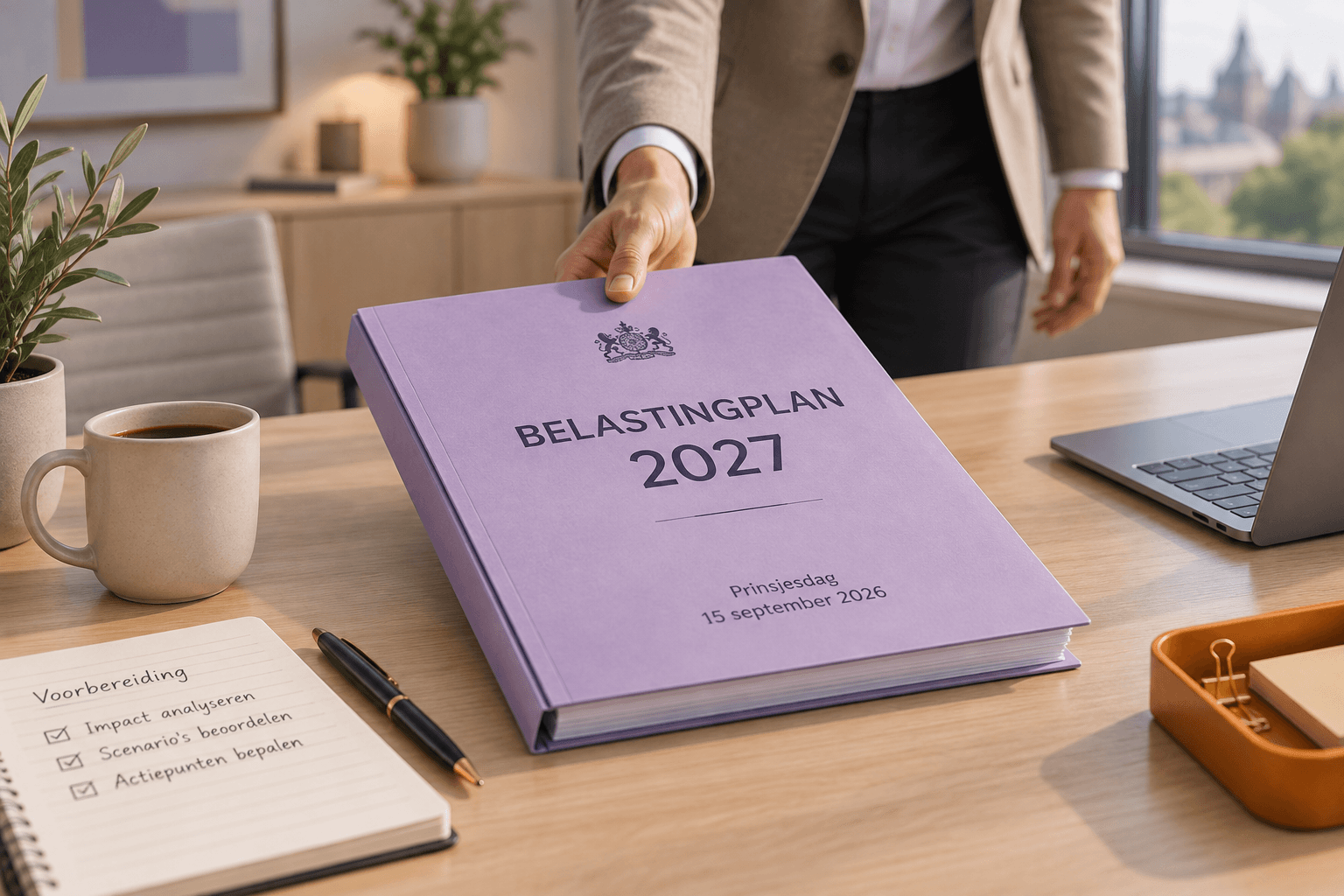
On Tuesday, 15 September 2026, the Kabinet-Jetten presents the Belastingplan 2027 to the Tweede Kamer, the annual package setting out the Dutch tax rules for the coming year. That moment has not happened yet. What follows is a preview built from the coalition agreement, the Voorjaarsnota 2026, the Fiscale verzamelwet 2027, and the evaluations the cabinet has already published, the documents that shape what actually gets presented on the day itself.
Two things are worth knowing before any of the specifics. First, this is a minority cabinet, D66, VVD, and CDA holding just 66 of 150 Tweede Kamer seats, which means every measure needs additional opposition support to survive the parliamentary process running through October, November, and into December. Some of what follows will land unchanged; some will be softened, delayed, or dropped entirely before a final vote. Second, several of the measures below come from multi-year trajectories already locked into earlier legislation, the zelfstandigenaftrek phaseout among them, and those are about as close to certain as anything gets before a formal vote.
One element worth flagging that gets less attention than the specific deductions: the coalition agreement includes a new "vrijheidsbijdrage," a solidarity contribution intended to help fund higher defence spending, expected to be implemented by limiting how fully income tax brackets and heffingskortingen are corrected for inflation in 2027 and 2028 rather than as a separately named tax. In practice, this means bracket thresholds may rise by less than actual inflation for two years running, quietly increasing the effective tax burden even where headline rates stay unchanged. A separate measure also under discussion would reduce overdrachtsbelasting, the property transfer tax, for private investors from 8% to 7% from 2027, a detail relevant to anyone weighing residential investment property decisions around the same year-end.
Key takeaway: Nothing in the Belastingplan 2027 is actually law until the Tweede Kamer votes in November and the Eerste Kamer follows in December. What is worth doing now is treating the measures already locked into prior legislation as effectively final, and everything newly proposed this year as likely but not guaranteed, so your year-end planning is not caught flat-footed either way.
The table below pulls together what is currently expected across the areas that matter most to Dutch entrepreneurs, based on the coalition agreement, the Voorjaarsnota 2026, and the Fiscale verzamelwet 2027. Treat the "from when" column as a strong expectation rather than a locked date until Prinsjesdag itself confirms it.
Measure (expected) | From when | Who is affected | What to do now |
|---|---|---|---|
Zelfstandigenaftrek to €900, frozen through 2036 | 2027 | All IB-ondernemers | Claim the full €1,200 for 2026 while it lasts |
Startersaftrek reduced, then abolished | 2027 / 2028 | New entrepreneurs in their first years | Consider starting sooner rather than later if this suits your plans |
Stakingsaftrek and meewerkaftrek cut to roughly 25% of current level | 2027 | Founders winding down; partners working unpaid | Reassess timing of closure, or a formal salary for a working partner |
Kilometervergoeding to €0.25, possibly retroactive to 1 Jan 2026 | 2026/2027 | All employers and IB-ondernemers with business travel | Hold correction calculations ready pending confirmation |
New levy on non-electric company cars | From 2027 (new assignments) | Employers providing company cars | Consider ordering electric vehicles before year-end |
WKR vrije ruimte modestly increased | 2027 | All Dutch employers | Revisit staff benefit budgeting once confirmed |
Branche-eigen producten exception removed from WKR | 2027 | Retail, hospitality, staff-discount sectors | Plan an alternative WKR category for existing discounts |
Pensioengrondslag frozen at €137,800 | 2027 through 2032 | Higher earners; DGAs on payroll | Review pension planning with an advisor |
Youngtimerregeling age threshold raised | 2027 | DGAs with older company cars | Check whether your vehicle will still qualify |
VPB and box 2 rates unchanged | N/A | All BVs and DGAs | No action needed on rates specifically |
€500,000 excessief lenen threshold unchanged | 2026 peildatum | DGAs with a rekening-courant balance | Continue planning around €500,000, not €700,000 |
Box 3 werkelijk rendement system | From 2028 | Anyone with meaningful savings or investments | Start understanding the new system's impact now |
Since the underlying VPB and box 2 rates form the backdrop against which all of this plays out, how much tax you pay covers that current baseline in full.
If You Are Self-Employed, Expect Your Deductions to Keep Shrinking
For ZZP freelancers, sole traders, and VOF partners, the trajectory already locked in continues exactly the direction of the last four years: smaller deductions, higher taxable income, with the MKB-winstvrijstelling remaining the one cushion untouched throughout. The zelfstandigenaftrek, already reduced to 1,200 euros for 2026, is scheduled to drop to 900 euros in 2027, and this time the number is expected to stay frozen there through 2036 rather than continuing to shrink further, which at least offers something closer to long-term certainty even at a lower level.
The startersaftrek picture looks less settled but more consequential for anyone weighing whether to start a business soon. It is expected to be reduced in 2027 and abolished entirely from 2028, meaning someone starting in 2026 still qualifies for the current 2,123-euro amount this year, while someone waiting until 2027 gets a reduced figure, and 2028 offers nothing at all. Anyone seriously considering starting a business in the near future has a real reason to move that decision forward rather than let it drift.
Two further reductions are widely expected but rarely get the attention they deserve. The stakingsaftrek, claimed when winding down a business, and the meewerkaftrek, claimed where a partner works unpaid in the business, are both expected to be cut to roughly a quarter of their current level from 2027. For a founder planning to wind a business down, or a partner currently working unpaid at close to full-time hours, this genuinely changes the arithmetic; a meewerkaftrek currently worth up to 4% of profit at 1,750-plus hours would fall to something closer to 1%, meaning an 80,000-euro-profit business would see that specific deduction drop from around 3,200 euros to something nearer 800.
A newer measure worth flagging separately targets entrepreneurs who run both an eenmanszaak and a BV with overlapping activities between the two. The cabinet is expected to propose restricting ondernemersfaciliteiten in exactly this samenloop situation, and anyone in that specific position should have their structure reviewed before the details firm up. Since deciding whether and when to start a business connects directly to these deductions, starting a company in the Netherlands is worth reading alongside this, and the full mechanics of the phaseout itself sit in zelfstandigenaftrek.
For Employers, the Company Car Is Where the Real Money Sits
Among everything being previewed for 2027, the measure with the most direct cash impact on Dutch employers concerns company cars, and specifically what happens to non-electric ones assigned from 2027 onward. A new employer-side levy on fossil-fuel company cars is under active discussion as part of the broader push toward electrification, sitting on top of the bijtelling employees already pay personally, and existing car arrangements already in place are expected to receive transitional protection running for several years past the change itself. Employers planning to hand out new company cars in 2027 have a genuine reason to place electric vehicle orders before the end of 2026 rather than after, since electric vehicles are expected to sit outside whatever new levy actually emerges from the final text.
On a more favourable note, the WKR vrije ruimte, the tax-free budget employers have for staff benefits, is expected to rise modestly on the first bracket, giving most Dutch employers a bit more breathing room for staff benefits without additional tax cost. That said, a specific carve-out for branche-eigen producten, staff discounts on a company's own products common in retail and hospitality, is expected to disappear at the same time, meaning employers currently relying on that exception need to plan for those discounts consuming ordinary vrije ruimte instead, or find another WKR category for them.
The zakelijke kilometervergoeding, the tax-free reimbursement rate for business travel, is expected to rise from 0.23 euros to 0.25 euros per kilometre, and, notably, the change under discussion would apply retroactively to 1 January 2026 rather than only from 2027. Employers who have been reimbursing at the lower rate all through 2026 should be ready to process a correction for the difference once the final rate is confirmed, rather than waiting until year-end to sort it out.
The pensioengrondslag, the salary ceiling used for pension accrual calculations, is confirmed as frozen at 137,800 euros through 2032 rather than rising with inflation as it normally would, a measure that directly reduces future pension accrual capacity for higher earners and DGA founders drawing salary through their own BV. Since this pension freeze and the car changes both touch payroll directly, hiring staff as a sole proprietor covers the broader employer obligations these changes sit alongside.
For DGA Founders, the Headline Is What Is Not Changing
For BV founders and DGAs, the most useful piece of planning information heading into Prinsjesdag might genuinely be what is expected to stay exactly as it is. VPB rates are expected to remain at 19% up to 200,000 euros and 25.8% above, box 2 rates are expected to hold at 24.5% and 33%, and the 500,000-euro excessief lenen threshold is expected to remain in place for the 31 December 2026 peildatum, with the coalition's own proposal to raise it to 700,000 euros still sitting unenacted and no clear signal it lands in this specific package either.
That stability matters for planning, but it does not mean nothing changes for this group at all. The youngtimerregeling, the favourable bijtelling treatment for older company cars, is expected to see its qualifying age threshold pushed out considerably, meaning any DGA currently relying on this for a classic or older vehicle should check whether that car will still qualify once a final age threshold is confirmed. The samenloop measure covered above for IB-ondernemers running a parallel BV applies with equal force here, and deserves the same structural review.
Watch out: The excessief lenen rules are expected to receive technical clarifications around how inherited box 2 income and cross-border immigration situations interact with the existing threshold. These are described as clarifications rather than a change to the 500,000-euro figure itself, but any DGA with an international background, an inherited shareholding, or a complex estate should confirm how the final wording actually affects their specific position once it is published.
For DGAs actively working down a rekening-courant balance before year-end regardless of what Prinsjesdag brings, borrowing from your own BV covers the practical reduction strategies in full, and how salary and dividend interact with all of this is worth reading in DGA salary vs dividend.
Box 3 and the Countdown Nobody Should Ignore
The single biggest story for Dutch wealth and investment heading into Prinsjesdag 2026 is not really anything new being announced this year at all; it is the confirmation of a system already in motion. The new box 3 approach, taxing werkelijk rendement, actual investment return, rather than a deemed forfaitair return, is on track to take effect from 1 January 2028, with the Belastingplan 2027 expected to finalise the legislative text the Tweede Kamer already approved in principle earlier in 2026, pending an Eerste Kamer vote still to come. That leaves roughly fifteen months for anyone with meaningful savings, investments, or a second property to actually understand how the new system will treat their specific holdings, rather than discovering it once it is already live.
For 2027 itself, box 3 stays on the existing forfaitaire system one more time, with rates and the heffingsvrij vermogen threshold updated for inflation as usual rather than restructured outright. The tax advantages attached to groen beleggen, green investment products, are expected to shrink substantially in 2027 and disappear entirely by 2028, which is worth weighing directly against whatever return those products still offer once the tax benefit is mostly gone.
A genuinely favourable change under discussion for startup and scale-up shareholders would shift how those specific shares are taxed inside box 3 from 2028 onward, moving from an annual tax on value changes to a tax applied only when the shares are actually sold, a meaningful improvement for early employees and angel investors who currently face a tax bill on paper gains they have not yet realised. Separately, the aftrek for specific medical costs above a threshold is expected to be abolished from 2028, though not before then, meaning the 2026 and 2027 aangiften can still include these costs where they genuinely qualify. Since a shift of this scale is exactly the kind of thing worth planning a provisional assessment around well before it lands, provisional tax assessment Netherlands covers how that planning tool works.
Get Ready for 15 September, Not After It
Waiting until the Belastingplan 2027 is actually published to start thinking about any of this puts you a full parliamentary season behind anyone who started planning around the direction these measures are already pointing. The specifics may shift once the actual text lands and moves through the Tweede Kamer and Eerste Kamer, but the broad shape, shrinking IB deductions, a costlier path for fossil company cars, stable VPB and box 2 rates, and a box 3 overhaul still on schedule for 2028, is unlikely to reverse entirely between now and January.
If you want help understanding what any of this actually means for your specific business once the details are confirmed, book a demo and we will walk through your situation directly. Our team can also help you incorporate your BV or get bookkeeping and payroll running on a foundation built to adapt as these rules actually finalise.
FAQs
What is the Belastingplan 2027 and when is it announced?
It is the Dutch government's annual tax package for the following year, presented to the Tweede Kamer on Prinsjesdag, which falls on 15 September 2026 this year. Most measures, once approved, take effect from 1 January 2027.
Are the Belastingplan 2027 measures already law before Prinsjesdag?
No. Nothing is law until after Prinsjesdag, once the Tweede Kamer debates and votes, typically in October and November, followed by the Eerste Kamer in December. Everything described ahead of that date is a preview based on the coalition agreement, the Voorjaarsnota, and prior policy documents, not a confirmed final text.
What is expected to happen to the zelfstandigenaftrek in 2027?
It is scheduled to drop from 1,200 euros in 2026 to 900 euros in 2027, with that lower figure expected to remain frozen through 2036 rather than continuing to shrink in later years.
Is the startersaftrek expected to be abolished?
It is expected to be reduced in 2027 and abolished entirely from 2028, making 2026 and 2027 the last two years a new entrepreneur can claim any version of it.
Will company car costs increase for employers in 2027?
A new levy on non-electric company cars assigned from 2027 is under discussion as part of the push toward electrification, alongside the bijtelling employees already pay, though the exact structure and rate remain to be confirmed on Prinsjesdag itself.
Is the VPB rate changing in the Belastingplan 2027?
No change is expected. VPB rates are expected to remain at 19% up to 200,000 euros of profit and 25.8% above that threshold.
What is happening to box 3 in 2027?
Box 3 is expected to remain on the existing forfaitaire system for one more year in 2027, with the new werkelijk rendement system still on track to take effect from 1 January 2028.
Is the €500,000 DGA loan threshold expected to change?
No increase is currently expected for the 31 December 2026 peildatum. The coalition's own proposal to raise the threshold to 700,000 euros remains unenacted, and the 500,000-euro figure is expected to continue applying.
What is expected to happen to the WKR vrije ruimte in 2027?
A modest increase to the first bracket is under discussion, which would give most Dutch employers slightly more tax-free room for staff benefits, though a specific exception for staff discounts on a company's own products is expected to be removed at the same time.
What should I do before 31 December 2026 based on these expectations?
Review whether your business structure, company car plans, and any pending business start or wind-down decisions are sensitive to the direction these measures are heading, and revisit the specifics once the actual Belastingplan 2027 text is published on 15 September.

Written by
Nick Knuppe
CEO & Founder