Credit Cards
Do you need a business bank account for a BV in the Netherlands? A complete guide
Do you need a business bank account for a BV in the Netherlands? Learn requirements, costs, KYC process, timing, and approval tips.
•
12 min
Intro
If you are setting up a BV in the Netherlands, one of the first practical questions you face is what to do about banking. Is a business bank account legally required? Which documents do you need? Can you open one as a foreign founder? And which bank or fintech actually makes sense for your situation?
This guide covers everything you need to know, from the legal obligation to the step-by-step process, documents, costs, and the most important providers in the market today.
Do you need a business bank account for a BV in the Netherlands?
Yes. For a BV (Besloten Vennootschap), a dedicated business bank account is a legal requirement. Unlike a sole proprietorship or VOF, a BV is a separate legal entity with its own legal personality. This means the BV's assets and liabilities are entirely separate from those of its shareholders and directors by law.
When you incorporate a BV, the notary is required to confirm that the paid-up share capital has been deposited into a bank account held in the name of the company being established. Without a business bank account, the BV cannot legally be incorporated. There is no workaround.
Beyond incorporation, a BV without a dedicated business account cannot function in practice either. It cannot receive client payments under its own name, pay suppliers, run payroll, file VAT returns properly, or produce the accurate financial statements it is legally required to submit to the Chamber of Commerce every year.
The short version: a business bank account is not optional for a BV. It is a legal, operational, and compliance necessity from day one.
What is a business bank account and why does a BV need one?
A business bank account is a payment account held in the name of the company, used exclusively for the company's financial transactions. It is distinct from any personal account held by the directors or shareholders.
For a BV specifically, a dedicated business account serves several essential functions:
Legal separation of assets. Because a BV is a legal entity separate from its founders, the company's money must be held separately. Mixing BV funds with personal funds undermines this separation and can create personal liability for directors in certain circumstances.
Clean financial administration. The Dutch Tax Administration (Belastingdienst) requires BVs to keep an accurate, transparent administration. A business account makes it possible to trace all income, expenses, and VAT flows clearly, which is essential for the quarterly VAT return, the annual corporate tax return, and the annual accounts.
Compliance with anti-money laundering rules. Under the Wet ter voorkoming van witwassen en financieren van terrorisme (Wwft), financial institutions and the government must be able to verify the source and flow of business funds. A business account in the company's name provides that traceability.
Professional credibility. Payments made under the company's name rather than a personal name build trust with clients, suppliers, and financial institutions. Most serious business clients and public sector bodies will not pay into a personal IBAN.
Banking integrations and iDEAL. Dutch business accounts connect to accounting software, give access to iDEAL payment processing, and support SEPA transfers, all of which are standard expectations for operating a business in the Netherlands.
When should you open a business bank account for your BV?
The timing matters. You need to open a business bank account before or at the moment of incorporation, not after.
The notary who drafts the deed of incorporation for your BV needs to confirm that the company's share capital has been deposited into an account in the company's name. In practice, this means you typically need to open the account in the pre-incorporation stage, as an account "in formation" (i.v.o.), and then convert it to a full business account once the BV is formally registered.
The practical sequence looks like this:
Start the bank account application process early, ideally before or alongside the notary appointment.
At the time of signing the deed of incorporation, the notary confirms the share capital deposit.
Once the BV is registered with the KVK and you have your KVK number, the account transitions to a full active business account.
Starting the banking process too late is a common error for first-time founders. Some traditional banks take two to six weeks to complete their KYC (Know Your Customer) review and approve a new business account. Starting early avoids delaying your entire incorporation timeline.
How to open a business bank account for a BV: step by step
The process differs slightly between traditional banks and fintech providers, but the core steps are consistent:
Step 1: Choose your banking provider. Decide between a traditional Dutch bank (ING, ABN AMRO, Rabobank) or a fintech provider (Neno, Revolut Business, Wise Business, Finom). Traditional banks offer full-service relationships, in-branch support, and access to credit products. Fintechs offer faster onboarding, lower fees, and accounting software integrations, but may have restrictions for certain business types.
Step 2: Gather your documents. Collect all required documents for directors, shareholders, and the company itself (see the next section for a full list).
Step 3: Submit your application. Most providers now allow you to start online. Some require an in-person visit or a video call, particularly for foreign-owned BVs.
Step 4: KYC review. The bank conducts identity verification and anti-money laundering checks on all directors, shareholders, and Ultimate Beneficial Owners (UBOs). For straightforward applications, this can take a few days with fintech providers. For traditional banks, particularly with foreign-owned structures, allow two to six weeks.
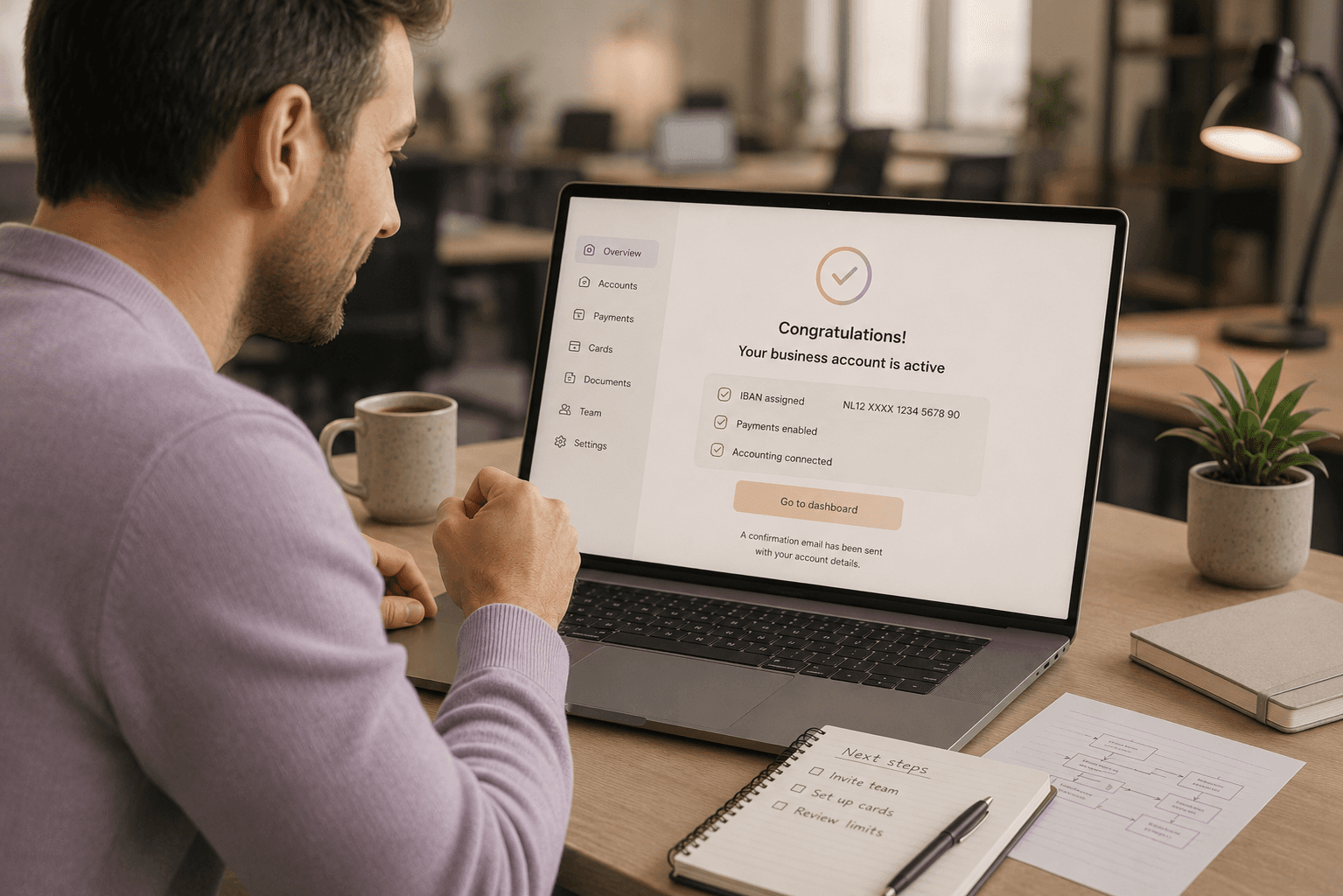
Step 5: Account activation and IBAN issuance. Once approved, you receive your Dutch IBAN and access to online banking. For the notary to confirm share capital deposit, you need this account number.
Step 6: Integrate with your administration. Connect your account to your bookkeeping software (Exact Online, Moneybird, Snelstart, or others) to automate transaction categorization and keep your administration current.
What documents are required to open a BV business account?
Banks in the Netherlands are bound by the Wwft, which requires thorough verification of business customers. The following documents are typically required:
Company documents:
KVK extract (uittreksel Handelsregister), confirming the BV's registration
Articles of association (statuten), as notarised at incorporation
Deed of incorporation (oprichtingsakte)
UBO registration confirmation from the KVK
For all directors and UBOs (anyone holding more than 25% of shares or effective control):
Valid passport or EU identity card
Proof of residential address (recent utility bill or bank statement, generally no older than three months)
For non-Dutch residents: documents may need to be translated into Dutch or English, and in some cases apostilled or legalized depending on the country of origin
Additional documents that are often requested:
Business plan or description of business activities and how the account will be used
Overview of the expected transaction volume and payment flows
VAT number (if already assigned)
Shareholder structure diagram, particularly for companies with corporate shareholders
For foreign-owned BVs or complex ownership structures:
Constitutional documents of any foreign parent or shareholder company, often requiring apostille or consular legalization
Proof of the economic substance of the BV's activities in the Netherlands
The more complex your ownership structure, the more documentation the bank will request. Simple BVs with Dutch resident directors typically face a much smoother application process than foreign-owned structures with multiple layers of corporate ownership.
Can foreign founders open a Dutch business bank account?
Yes, foreign founders can open a Dutch business bank account, but the process is more involved than for Dutch residents, and not all banks are equally accessible to non-residents.
Key points to know:
KVK registration is the starting point. Most banks require your BV to be registered with the KVK before they will process a full application. Without a KVK number, your path to a Dutch IBAN is significantly narrowed.
Dutch business address is required. A physical or registered Dutch business address is needed for KVK registration and is typically required by banks as well. A virtual office address can satisfy the KVK requirement, but most traditional banks will not accept a virtual office as a residential address for the director. If no director has a genuine Dutch residential address, this can create friction with traditional banks.
A local director helps but is not legally mandatory. The Netherlands allows full foreign ownership of a BV, and you are not legally required to appoint a Dutch resident director. However, some traditional banks have informal preferences for at least one director with a Dutch residential address. Fintech providers are generally more flexible on this point.
Fintech providers are often more accessible for non-residents. Providers such as Bunq, Revolut Business, Wise Business, and Finom offer remote onboarding and are generally more straightforward for internationally-based founders, provided the company is KVK-registered and the required documents are in order.
The Quick Scan tool for foreign companies. If your company is supported by the Netherlands Foreign Investment Agency (NFIA) or a recognized start-up facilitator, you can submit a Quick Scan to participating banks (ABN AMRO, ING, Rabobank) for an initial eligibility assessment within five working days. This is a practical route for foreign-owned businesses that want to access traditional Dutch banking.
Foreign documents may need apostille or legalization. Identification documents, articles of association, and constitutional documents from outside the Netherlands may need to be translated and, depending on the country of origin, apostilled or otherwise legalized before a bank will accept them.
What are the requirements to get approved by a Dutch bank?
Getting approved is not automatic. Dutch banks apply rigorous KYC and AML (Anti-Money Laundering) checks to every business account application, and some applications are rejected or significantly delayed.
The main factors that affect approval:
Clean UBO structure. Banks need to identify every natural person who ultimately owns or controls more than 25% of the BV. Complex or opaque ownership structures (especially those involving multiple holding companies or offshore entities) receive much greater scrutiny and can result in rejection if the bank cannot satisfactorily verify the beneficial owners.
Clarity of business activities. Banks will assess whether they understand what your business does and whether the expected cash flows make sense. Businesses in certain sectors (crypto, gambling, high-risk financial services, cannabis-adjacent industries) face heightened or absolute restrictions at many traditional Dutch banks.
Substance in the Netherlands. Banks look for evidence that the BV has genuine economic activity in the Netherlands. A company that exists purely on paper with no real activities, employees, or clients raises red flags under Dutch AML rules.
Directors' identities and backgrounds. All directors must be verifiable individuals with clean backgrounds. Banks will screen against international sanctions lists and fraud databases as part of standard KYC.
Accurate UBO registration. Your UBOs must be correctly registered with the KVK before or during the banking application. Incorrect or missing UBO registration is one of the most common reasons for delays and rejections.
Practical tip: if you have a non-standard ownership structure or operate in a complex sector, consider engaging an accountant or financial services advisor who can help prepare your application and brief the bank on your business model before you apply.
What does a business bank account cost for a BV?
The cost structure varies significantly between traditional banks and fintech providers.
Traditional banks (ING, ABN AMRO, Rabobank)
Traditional banks typically charge a fixed monthly fee plus transaction fees. Based on current 2026 pricing:
ING Business: approximately €3.45 per month for basic accounts; SEPA transfers are free; international (non-SEPA) payments carry a 1.4% exchange rate surcharge.
ABN AMRO Business: plans start from around €9.90 per month (Smart plan) up to €22.25 per month (Borderless plan), with the higher tiers including features such as accounting support and multiple business accounts.
Rabobank Business: the basic account carries a monthly fee of approximately €4.85; SEPA transfers are free; non-SEPA currency payments attract a 1.4% surcharge and cash withdrawals outside the EEA cost €3.50 per transaction.
Traditional banks offer the advantage of in-branch support, access to credit products (business loans, overdrafts), and established relationships with Dutch counterparties. They are generally the preferred choice if you anticipate needing financing.
Fintech providers
Fintech business accounts typically have lower or no monthly fees, faster onboarding, and stronger software integrations, but may offer fewer credit products and less in-person support.
Neno: Modern all-in-one banking, exoense management invoicing & accounting and payroll and tax built into one AI native solution.
Revolut Business: strong multi-currency support (25+ currencies), good for businesses with international clients; paid plans starting from around €10 per month.
Wise Business: low-cost international transfers with transparent fees; good for businesses with significant foreign currency activity.
Finom: growing fintech with real-time bookkeeping integrations and competitive pricing for small businesses.
What to consider beyond the monthly fee:
Transaction fees for outgoing SEPA transfers
International payment fees and exchange rate margins
Card issuance and usage fees
Integration with your accounting software (Exact Online, Snelstart, Moneybird, etc.)
iDEAL access (essential for selling to Dutch consumers)
Customer support language and availability
For most BVs, the total cost of banking is modest relative to total business costs. The more important decision is choosing a provider whose features, integrations, and support model fit how you actually run your business.
Best banks for BV business accounts in the Netherlands
There is no single best bank for every BV. The right choice depends on your business model, transaction volume, international exposure, and how important things like bookkeeping integrations and customer support are to you. Here is a practical overview:
For Neno clients: as part of our integrated financial services offering, Neno operates embedded banking infrastructure via Swan, providing BV clients with a streamlined business account setup alongside their accounting, VAT, payroll, and tax administration. Rather than managing banking as a separate process with a separate provider, Neno clients access their business banking within the same environment as their entire financial administration, reducing friction and keeping everything in sync.etherlands. It has dedicated services for expats and foreign-owned businesses, offers a 90-day BSN grace period, and is generally considered more accommodating to non-resident founders than its peers. Its tiered business account plans cover most needs from basic to multi-account setups.
Rabobank has a large SME and agricultural focus. It is a familiar name for established Dutch businesses but has limited English infrastructure and tends to be more demanding during the application process for foreign-owned companies.
Revolut Business is the strongest option for BVs with significant international payment volumes. Multi-currency accounts, competitive FX rates, and strong expense management tools make it well suited for e-commerce and consulting businesses with EU or global clients.
Wise Business is excellent for businesses that frequently need to send money internationally, due to its transparent, low-cost transfer model. Less suited as a primary operating account for high-volume domestic businesses.
Can you use a personal bank account for a BV?
No. This is one of the clearest rules in Dutch company law and practice. For a BV, you cannot use a personal bank account for business transactions, for the following reasons:
It is legally incompatible with the BV structure. A BV is a separate legal entity. Its assets must be held in the company's name, not in the personal name of a director or shareholder. Using a personal account would undermine the legal separation that is the entire point of the BV structure.
It creates personal liability risk. One of the main advantages of a BV is that directors and shareholders are generally not personally liable for the company's debts. If company funds are held in a personal account, the legal separation between the person and the company is compromised, which can expose the director to personal liability claims.
It violates the Belastingdienst's administration requirements. The Belastingdienst requires BVs to maintain a clean, transparent administration. Mixing company and personal finances on one account makes it impossible to produce accurate tax returns and creates serious compliance risk.
Banks will not allow it. In practice, the KYC requirements that clients and suppliers apply when paying a BV will also quickly surface the issue. Business clients expect to pay into a business account in the company's name. A personal IBAN on a BV invoice will raise immediate questions.
For sole proprietors and zzp'ers, the legal position is different: a separate business account is not strictly required by law (though the Tax Administration effectively makes it necessary in practice). For a BV, there is no such ambiguity.
At Neno, we help Dutch BVs and growing SMEs manage their full financial administration, from business banking and bookkeeping to VAT, payroll, and tax, all in one place. If you are setting up a BV and want to get your banking and financial administration right from day one, get in touch with our team.
This article reflects the rules and market landscape applicable in 2026. Banking fees and product offerings change regularly. Always verify current pricing directly with the provider before making a decision.

Written by
Nick Knuppe
CEO & Founder