BV Formation
How to transfer shares in a Dutch BV to a co-founder or investor
Dutch BV share transfer explained: from investor entry to founder exit. Avoid delays and understand the full legal and financial process.
•
19 min
Intro
Transferring shares in a Dutch BV is not something you can do with a simple contract or informal agreement between shareholders. A BV is a private limited company with a formal share capital structure, and ownership changes must follow Dutch company law, the articles of association and the notarial process. Whether you are selling shares to a co-founder, bringing in an investor, buying out a partner or transferring ownership within a family business, the process needs to be handled carefully.
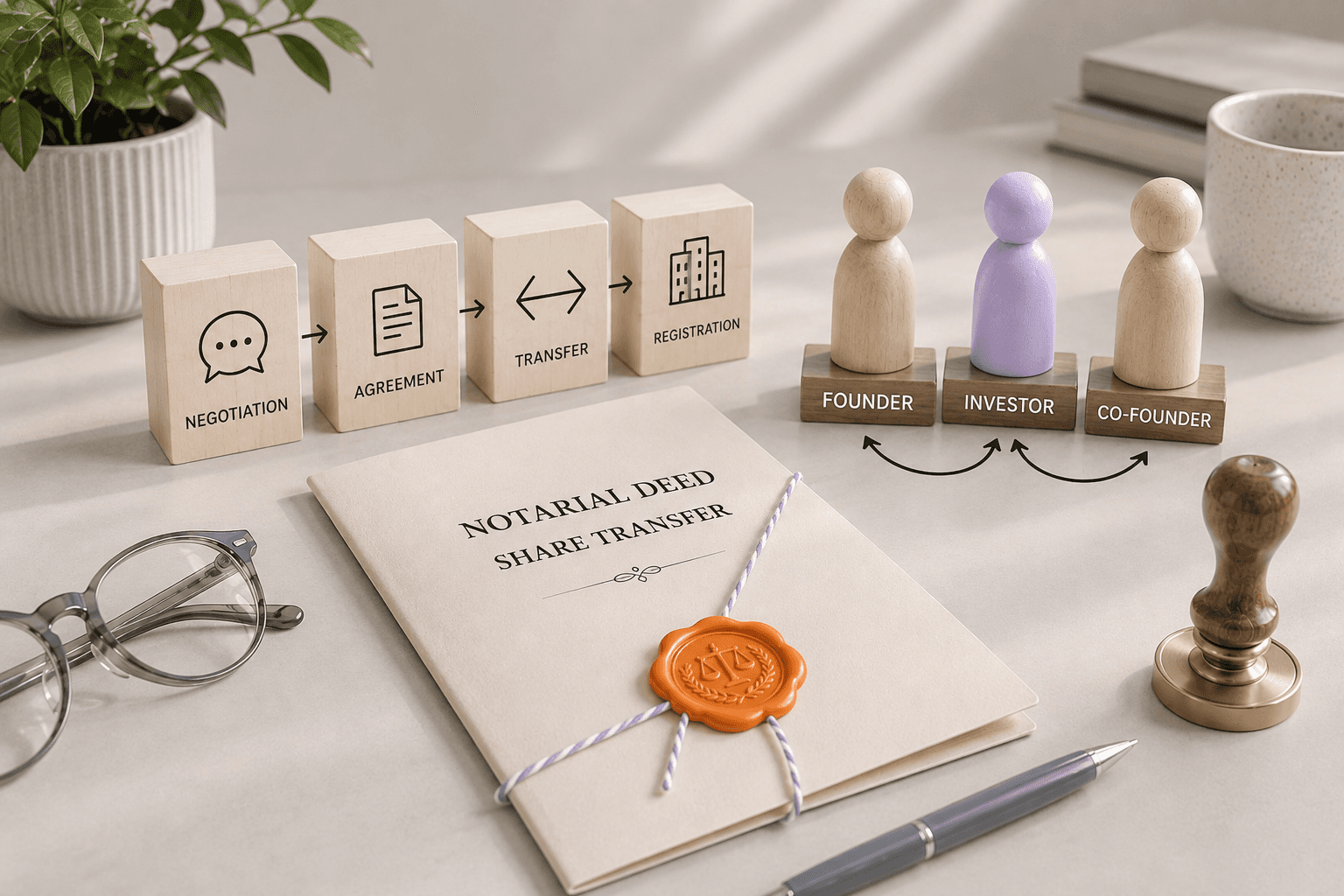
A share transfer can have legal, financial and tax consequences for both the seller and the buyer. It affects voting rights, dividend rights, control over the company and sometimes the wider structure of the business. In 2026, many parts of the process can be prepared digitally, but the legal transfer of BV shares still requires a Dutch civil-law notary and a notarial deed. This guide explains how the process works, what to check before signing anything and where founders often make mistakes. Dutch BV share transfers require a notarial deed, and the articles of association may contain transfer restrictions such as approval clauses or offering obligations.
What Is a Share Transfer in a Dutch BV?
A share transfer in a Dutch BV means that one shareholder transfers ownership of existing shares to another person or legal entity. This can be another founder, an investor, a holding company, a family member or an external buyer. The buyer does not acquire individual assets of the company, but rather an ownership stake in the BV itself.
That distinction is important. Shares represent participation in the company and usually come with rights such as voting rights, dividend rights and economic exposure to the value of the business. When shares are transferred, those rights move with the shares unless the articles of association or a shareholder agreement create specific limitations.
What transfers with the shares?
In most cases, the buyer receives the rights attached to the shares being transferred. These may include voting rights, dividend rights and the right to share in the company’s value if it is sold or liquidated. If the BV has different share classes, such as ordinary shares and preference shares, the rights may differ per class.
This is why it is essential to check not only the number of shares being transferred, but also the rights attached to them. Ten percent of ordinary shares may have a very different economic and control effect than ten percent of a special class with limited voting or preferential dividend rights.
Shares are not the same as assets
Buying shares in a BV is different from buying the company’s assets. In a share transfer, the company remains the same legal entity. Its contracts, employees, liabilities, tax history and obligations generally remain inside the BV. The buyer steps into ownership of the company, including the upside and the risks.
In an asset deal, by contrast, selected assets and liabilities are transferred. That may include equipment, contracts, intellectual property or customer relationships. The difference matters because risk, tax treatment and legal documentation can be very different.
Why Shareholders Transfer BV Shares
Share transfers happen for many different reasons. Sometimes the company is growing and needs a new investor. Sometimes one founder wants to exit, while the remaining shareholders continue. In other cases, a family business is being transferred to the next generation or an entrepreneur sells the entire company.
The reason for the transfer has a big influence on the structure of the deal. A co-founder transfer is usually different from an investor round. A family succession is different from a commercial sale. Before starting the process, it helps to be clear about the commercial reason behind the transaction.
Selling to a co-founder
A shareholder may transfer shares to another co-founder when roles change or when one founder takes on more responsibility. This often happens in early-stage companies where ownership needs to be aligned with actual contribution.
Bringing in an investor
When an investor joins, the deal may involve either the transfer of existing shares or the issue of new shares. In many startup transactions, investors prefer new shares so their investment flows into the company rather than to an exiting shareholder.
Family succession or business sale
In family businesses, shares may be transferred gradually to the next generation. In a business sale, the buyer may acquire part or all of the shares. Both situations require careful planning, especially around valuation, tax and control.
Buying out a partner
A buyout can happen when shareholders no longer want to continue together. These transactions are often sensitive because price, timing and control are all at stake. A clear shareholder agreement can make this process much easier.
Checking the Articles of Association Before You Start
Before negotiating a share transfer, you must check the BV’s articles of association. These articles often contain rules that restrict how shares can be transferred. Ignoring these rules can delay the transaction or even make the transfer impossible until the correct procedure has been followed.
Dutch BVs commonly include blocking clauses. These clauses are designed to prevent shares from being freely transferred to outsiders without giving existing shareholders or the company a say. The exact wording matters, so this is one of the first documents a lawyer or notary will review. BV articles may contain blocking clauses, such as approval procedures or offering obligations.
Blocking clauses
A blocking clause restricts the transferability of shares. It may require approval from a corporate body, such as the general meeting, or require the selling shareholder to offer the shares to existing shareholders first.
Approval clause
An approval clause means that the transfer needs approval before it can proceed. The articles usually specify who gives that approval and what happens if approval is refused.
Right of first refusal
A right of first refusal, often referred to in Dutch as an aanbiedingsregeling, means that a shareholder who wants to sell must first offer the shares to existing shareholders. Only if they decline can the shares usually be offered to an external buyer.
What happens if you ignore the articles?
If the transfer restrictions are ignored, the notary will usually not execute the deed. Even if parties have already signed a commercial agreement, the legal transfer cannot be completed without following the correct corporate procedure. This can create delays, renegotiation and sometimes disputes between shareholders.
How to Value BV Shares Before Transfer
Valuing BV shares is one of the most important and often most difficult parts of the process. The price is not automatically based on nominal share capital. A BV may have only a few euros of issued capital but still be worth hundreds of thousands or millions based on revenue, assets, intellectual property, contracts, growth potential or profitability.
The right valuation method depends on the type of company. A profitable mature business may be valued differently from an early-stage startup with little revenue but strong technology. Because valuation often becomes a negotiation point, it is important to document the assumptions behind the price.
Common valuation methods
Typical valuation methods include:
Discounted cash flow, based on expected future cash flows
Multiple-based valuation, based on revenue or EBITDA multiples
Net asset value, based on assets minus liabilities
Recent investment round valuation
Negotiated founder or investor valuation
For early-stage companies, the final price is often less about historic profit and more about future potential, investor appetite and dilution.
Role of a corporate finance specialist
For larger transactions, a corporate finance advisor may prepare a valuation report or information memorandum. This helps both buyer and seller understand the financial position of the company and supports negotiations.
What determines the share price?
The share price is influenced by financial results, growth prospects, risks, customer concentration, intellectual property, debt, working capital, tax position and deal terms. Minority shareholdings may also be valued differently from controlling stakes because they provide less influence over the company.
Negotiating the Share Transfer: Term Sheet and LOI
Before drafting the full share purchase agreement, parties often start with a term sheet or letter of intent. This document sets out the main commercial terms of the deal and helps confirm whether there is enough agreement to proceed with due diligence and legal documentation.
A term sheet is especially useful when there are multiple moving parts, such as price adjustments, conditions precedent, financing, warranties or investor rights. It reduces uncertainty and creates a roadmap for the transaction.
What to agree on upfront
The term sheet usually covers the number of shares, purchase price, payment timing, due diligence process, exclusivity, confidentiality, expected closing date and key conditions. For investor transactions, it may also include valuation, anti-dilution rights, board rights or future funding commitments.
Non-binding and binding terms
Many parts of a term sheet are non-binding, meaning they express commercial intent but do not yet create a final obligation to complete the transaction. However, clauses on confidentiality, exclusivity, costs and governing law are often binding.
Confidentiality and exclusivity
Confidentiality protects sensitive company information shared during negotiations. Exclusivity prevents the seller from negotiating with other buyers for a certain period. Both can be important, especially when strategic information is being disclosed.
Due Diligence in a Dutch BV Share Transfer
Due diligence is the buyer’s investigation into the BV before completing the purchase. Since the buyer acquires shares in the company, they also take economic exposure to the company’s history. That includes financial, legal, tax and operational risks.
For sellers, preparation is just as important. A clean due diligence process builds trust, reduces delays and may support a better valuation. Poor documentation, unclear financials or unresolved tax issues can quickly undermine a transaction.
What buyers usually check
Buyers typically review:
Annual accounts and management accounts
Tax filings and VAT position
Contracts with customers and suppliers
Employment agreements
Intellectual property
Loans and liabilities
Litigation or disputes
Corporate documents and shareholder agreements
The scope depends on the size and risk profile of the transaction.
Financial, legal and tax review
Financial due diligence checks whether the numbers are reliable. Legal due diligence checks ownership, contracts, liabilities and corporate approvals. Tax due diligence reviews VAT, wage tax, corporate tax and any historic exposure.
What sellers should prepare
Sellers should prepare a structured data room with all relevant documents. This avoids repeated requests and helps keep the process efficient. For a BV, this usually includes articles of association, shareholder register, financial statements, tax filings, contracts and corporate resolutions.
The Share Purchase Agreement for a Dutch BV
The share purchase agreement, often called an SPA, is the main contract between buyer and seller. It sets out the commercial deal and allocates risk between the parties. The notarial deed completes the legal transfer, but the SPA usually contains the broader transaction terms.
A well-drafted SPA is important because it deals with issues that the deed itself does not fully cover. This includes warranties, indemnities, payment mechanics, closing conditions and what happens if information later turns out to be incorrect.
What the SPA includes
A Dutch BV share purchase agreement typically includes:
Parties to the transaction
Number and class of shares
Purchase price and payment terms
Completion mechanics
Warranties and indemnities
Conditions precedent
Covenants between signing and closing
Liability limits
Governing law and dispute resolution
Warranties and guarantees
Warranties are statements made by the seller about the company. They may cover financial statements, tax compliance, contracts, ownership, employees and legal disputes. If a warranty is false, the buyer may have a claim.
Conditions precedent
Conditions precedent are conditions that must be satisfied before completion. Examples include shareholder approval, bank consent, investor approval, due diligence clearance or regulatory requirements.
The Role of the Notary in a Dutch BV Share Transfer
A Dutch civil-law notary is legally required for the transfer of BV shares. The parties can negotiate and sign a commercial agreement themselves, but the shares are not legally transferred until the notarial deed of transfer is executed. Every BV share transfer requires a notarial deed before a Dutch civil-law notary.
The notary checks the articles of association, verifies the parties, prepares the deed and updates the shareholder register. In many transactions, the notary also coordinates signing logistics and confirms that the legal transfer is properly completed.
Why the notary is required
Dutch law treats BV shares as registered shares that require formal transfer. The notarial deed provides legal certainty and ensures that ownership changes are properly documented.
What the notarial deed contains
The deed usually includes the identity of the seller and buyer, details of the BV, the shares being transferred, the legal basis for the transfer and confirmations that the required corporate procedures have been followed.
What documents are needed?
The notary typically needs:
Articles of association
Shareholder register
Identification of parties
UBO information
Corporate approvals
SPA or transaction terms
Power of attorney, if applicable
For foreign shareholders or corporate buyers, additional documents may be needed, such as extracts, legal opinions or apostilled documents.
Can You Transfer BV Shares Online?
Many parts of a BV share transfer can now be handled digitally. Documents can be collected online, identity verification can often be completed remotely and powers of attorney may be used when parties cannot attend in person.
However, online does not mean informal. The legal transfer still requires a Dutch notarial deed. The difference is that the preparation, verification and signing process can often be organised more efficiently through digital notary services.
Digital notary services
Digital notary services can reduce the need for physical appointments. This is especially useful when shareholders or buyers are based outside the Netherlands.
Remote identity verification
Depending on the notary and the parties involved, identity verification may be handled through secure remote processes. Foreign parties may still need additional legalisation or documentation.
Timeline for an online process
A straightforward online share transfer can sometimes be completed in a few business days once all documents are ready. More complex transactions, especially those involving foreign entities, investor rights or missing shareholder documentation, can take longer.
Retroactive Share Transfer in a Dutch BV
A retroactive share transfer means that the parties agree that the economic effects of the transfer apply from an earlier date than the legal transfer date. This may be relevant when the parties want profits, dividends or economic risk to be treated as belonging to the buyer from a prior date.
It is important to distinguish between economic and legal ownership. The legal transfer of BV shares only takes place when the notarial deed is executed. Parties can agree on retroactive economic effect in their contract, but this does not change the formal legal transfer date.
Economic versus legal transfer date
The legal transfer date is the date of the notarial deed. The economic transfer date can be agreed separately between the parties. For example, parties may sign in March but agree that economic risk transfers from 1 January.
Practical example
Suppose a shareholder sells 30 percent of the shares in March 2026, but the parties agree that the buyer is economically entitled to profits from 1 January 2026. The notarial transfer still occurs in March, but the SPA may allocate profits and risks from January.
Risks of retroactive transfer
Retroactive arrangements can create tax, accounting and dispute risks if they are not clearly documented. They should be reviewed carefully by legal and tax advisors.
Transferring BV Shares to a Co-founder
Transfers between co-founders are common in early-stage companies. Sometimes one founder wants to increase their stake. Sometimes another founder is leaving. In other cases, the original ownership split no longer reflects actual contribution.
These transfers can look simple, but they still require the same formal process. The articles must be checked, the price must be agreed and the notarial deed must be executed.
Pricing considerations
Co-founder pricing can be sensitive. If the company is still early-stage, the parties may agree on a relatively low price. If the company has grown, a market-based valuation may be needed.
Shareholder agreement
A shareholder agreement should address what happens when a founder leaves, fails to contribute or wants to sell. Good leaver and bad leaver provisions can prevent disputes later.
Dilution and control
A co-founder transfer changes ownership percentages and may affect voting power, dividend rights and control. Even small percentage changes can matter if they shift majority or veto positions.
Selling BV Shares to an Investor
Selling shares to an investor is different from a simple founder transfer. Investors usually want a clear valuation, due diligence, protective rights and a structure that supports future growth.
A key question is whether the investor buys existing shares from a shareholder or subscribes for newly issued shares. In a startup context, new shares are often preferred because the investment money goes into the company.
New shares versus existing shares
If existing shares are sold, the purchase price goes to the selling shareholder. If new shares are issued, the investment flows into the BV and existing shareholders are diluted.
Share premium
Investors may pay more than the nominal value of shares. The excess amount is usually treated as share premium, known in Dutch as agio. This is common in startup investment rounds.
What investors look for
Investors look at the cap table, IP ownership, financials, contracts, team, market potential, legal risks and future exit opportunities. A messy shareholder structure can make investment harder.
Tax on Selling BV Shares in the Netherlands
Tax is one of the most important parts of a BV share transfer. The tax treatment depends on who sells the shares, how the shares are held and whether the seller is an individual or a company.
If an individual owns at least 5 percent of the shares, this is generally a substantial interest. Gains from selling those shares are taxed in box 2. In 2026, box 2 has two rates: 24.5 percent up to €68,843 and 31 percent above that amount.
Box 2 taxation
For individual shareholders with a substantial interest, the sale gain is generally taxed in box 2. The taxable gain is usually the sale price minus the acquisition price and relevant costs.
Participation exemption through a holding company
If shares are held through a Dutch holding company, the participation exemption may apply if the holding company owns at least 5 percent of the subsidiary and meets the conditions. This can exempt qualifying dividends and capital gains from corporate income tax at holding level.
Transfer tax
A regular transfer of BV shares does not automatically trigger real estate transfer tax. However, special rules can apply if the BV is a real estate company. This should be checked carefully in property-heavy structures.
Selling at a loss
If shares are sold at a loss, the tax treatment depends on how the shares are held and whether the loss is recognised for tax purposes. For holding structures, the participation exemption can also limit deductibility of losses.
Share Transfer vs Asset Deal: What to Choose?
A share transfer and an asset deal can both be used to transfer a business, but they work very differently. In a share transfer, the buyer acquires the company. In an asset deal, the buyer acquires selected assets and liabilities.
The best option depends on tax, liability, contracts, employees and commercial goals. Buyers often prefer asset deals to avoid historic liabilities. Sellers often prefer share deals because they are cleaner and may be more tax efficient.
Liability implications
In a share deal, historic liabilities stay in the BV and indirectly transfer to the buyer. In an asset deal, the buyer may be able to select which liabilities are assumed, although some obligations may still transfer by law.
Tax treatment
Tax treatment differs significantly. A share deal may trigger box 2 taxation for an individual shareholder or participation exemption treatment for a holding company. Asset deals may trigger VAT, corporate tax and other transaction taxes depending on the assets involved.
When each makes sense
A share deal often makes sense when the buyer wants the entire company, including contracts, employees and history. An asset deal can make more sense when the buyer only wants specific assets or wants to avoid unknown liabilities.
How Long Does a BV Share Transfer Take?
The timeline depends on complexity. A simple transfer between existing Dutch-resident shareholders can be completed relatively quickly if the articles are clear and all documents are ready. More complex transactions involving investors, foreign entities, due diligence or financing can take weeks or months.
The notarial step itself is usually not the longest part. Delays often come from valuation discussions, missing documents, shareholder approvals, tax review or foreign legalisation requirements.
Typical timeline
A simple transfer may take one to two weeks. A more involved transaction may take four to eight weeks. Larger deals with due diligence and negotiations can take several months.
What causes delays?
Common delays include incomplete shareholder registers, unclear articles, disagreement on valuation, missing approvals, foreign documents, tax issues or unresolved shareholder disputes.
Online versus traditional timeline
Digital preparation can shorten the process, especially for straightforward transfers. However, the legal requirements remain the same, and complex transactions still require careful review.
FAQs About Dutch BV Share Transfers
Can a non-resident transfer BV shares?
Yes. Non-resident shareholders can transfer BV shares, but the notary may require additional identity verification, legalised documents or powers of attorney.
What if a shareholder refuses to sell?
A shareholder usually cannot be forced to sell unless the articles, shareholder agreement or a court procedure provides a basis. Buy-sell clauses, drag-along provisions and dispute mechanisms can be important.
Is a share transfer public?
The notarial deed itself is not generally public in the same way as the trade register. However, changes in shareholders may affect UBO registration or other company records.
Can a share transfer be reversed?
Reversing a transfer is not simple. Once shares are legally transferred, undoing the transaction usually requires a new legal act or legal grounds to challenge the transaction.
How Neno helps with BV share transfers
A share transfer is not only a legal transaction. It also affects your accounting, tax position, shareholder structure, banking setup and future reporting. At Neno, we help Dutch BV founders and growing companies keep the financial side of these changes organized from start to finish.
Neno brings together company administration, accounting, tax, VAT, payroll and business banking in one environment. If you are transferring shares, bringing in an investor or restructuring your BV, we help make sure the financial administration stays clean, compliant and ready for the next stage of growth.

Written by
Nick Knuppe
CEO & Founder